Managing a Distributed / Offshore Team
As of 2026-10-03
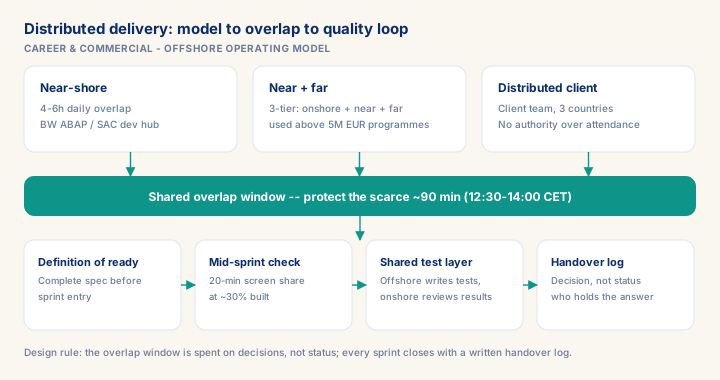
Distributed SAP analytics delivery fails on information asymmetry, not time zones: the three EMEA models -- near-shore, near+far, and distributed client -- each demand a different handover and escalation design. The one lever that actually moves outcomes is protecting the shared overlap window, often as little as 90 minutes, and replacing verbal status updates with written decision logs and mid-sprint touchpoints that catch errors at 30% completion instead of 100%. Consultants who can show a reduced defect-escape rate or a shortened unblock cycle from a distributed programme command day rates above roughly 900 EUR/day -- the market now treats this as a baseline senior competency, not a differentiator.
What you will learn
- Identify which distributed delivery model is in play -- nearshore, near+far, or distributed client -- and adapt your management approach accordingly
- Design handover artefacts and mid-sprint touchpoints that catch misunderstandings when they are 30% complete, not after a full sprint is wasted
- Establish decision authority boundaries so offshore team members can act autonomously on defined decisions without routing every question through a bottleneck
- Protect the overlap window as a scarce resource and schedule ceremonies to maximise its value for shared-understanding work
The Real Challenge of Distributed SAP Analytics Delivery
The difficulty is not time zones. It is information asymmetry and uneven accountability. Projects that struggle with distributed teams do not fail because of the 90-minute overlap window between Warsaw and Mumbai. They fail because the onshore team holds context that never makes it offshore, because offshore team members have learned that raising a blocker takes three days and usually results in being told to wait, and because the definition of 'done' is applied inconsistently across sites.
Before any conversation about ceremonies or handover templates, diagnose what kind of distributed model you actually have. There are three distinct configurations in EMEA SAP analytics delivery, and they require different management:
Prerequisites
- Intermediate hands-on experience on SAP analytics projects
- Review core concepts first: C058, C047, C087
Outcomes
- Work through a realistic scenario: A Frankfurt-headquartered industrial-equipment group runs a 14-month, roughly 6M EUR BW/4HANA-to-SAC migration: functional and architecture onshore in Frankfurt.
- Recognize and avoid the anti-pattern: Verbal-only handover, no written decision log — The next team inherits the ticket status but not the reasoning.
- Apply the module's core decision: Which distributed model are you actually running — choose Diagnose near-shore (4-6h overlap, BW/SAC dev centralised).
- Track mastery with the KPI: Defect escape rate from offshore sprints.
Full module available to members. The full module adds: the decision framework · the end-to-end scenario walkthrough · the KPI scorecard · the anti-patterns · the knowledge check · the diagrams.