Quality Gates: Your Reputation Insurance
As of 2026-10-03
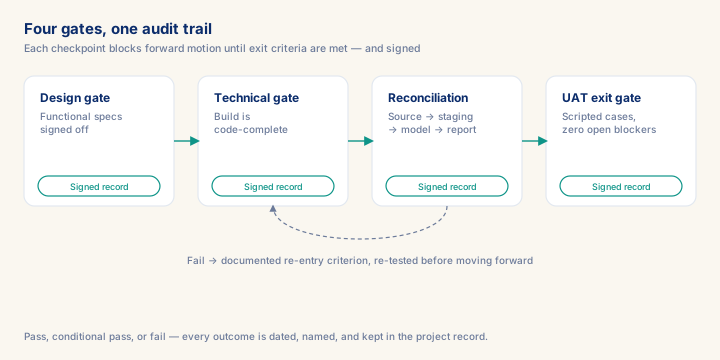
A quality gate is a documented checkpoint the client agreed to, not a status update you write the night before go-live: well-run SAP analytics phases run three to four of them, from design sign-off through UAT exit. The gate that consultants most often skip under deadline pressure is peer review, and the one where they most often lose credibility is data reconciliation — matching source, staging, model, and report before the client's controller does it for you. Consultants who can cite their own gate metrics — reconciliation accuracy, UAT first-pass rate above 95%, zero post-go-live restatements — defend a day rate €200 above market median; consultants who describe quality in general terms do not.
What you will learn
- Structure a project-phase quality gate with documented entry criteria, reviewer assignments, and signed exit records that create a defensible audit trail
- Design and execute a three-level data reconciliation check (source-to-staging, staging-to-model, model-to-report) that catches financial discrepancies before UAT
- Run a structured peer review for SAP analytics deliverables covering semantic correctness, navigation logic, and bilingual label accuracy
- Manage a failed gate outcome professionally by documenting root cause, communicating proactively to the client, and using the incident to strengthen rather than erode trust
What a Quality Gate Actually Is
A quality gate is a formal checkpoint, not a filing exercise. On an SAP analytics engagement—whether you are delivering a BW/4HANA migration, a SAC story suite, or a Datasphere data product—a quality gate is the moment where your team stops forward motion and asks a documented question: does this artefact meet the exit criteria we agreed with the client before we move to the next phase? The key word is agreed. A gate you define unilaterally the night before go-live is not a gate; it is a cover sheet.
In practice, well-run SAP analytics projects run three to four gates per phase: a design gate after functional specifications are signed, a technical gate after the build is code-complete, a data reconciliation gate before UAT begins, and a UAT exit gate before cutover. Each gate produces a record—pass, conditional pass with open items, or fail with a re-entry criterion—that you keep in the project repository. That record is your reputation insurance policy.
The Peer Review Layer
Internal peer review is the cheapest gate you will ever run, and the one most often skipped under deadline pressure.
Prerequisites
- Intermediate hands-on experience on SAP analytics projects
- Review core concepts first: C058, C047, C087
Outcomes
- Work through a realistic scenario: A European automotive supplier is migrating financial reporting from BW to a BW/4HANA and SAC model ahead of a fiscal year-end close. Finance will.
- Recognize and avoid the anti-pattern: Conflating gate completion with gate approval — A gate is marked done because the checklist items were touched, not because the exit criteria were actually met.
- Apply the module's core decision: How many gates to run per phase — choose Run the full sequence — design, technical, reconciliation, UAT exit — on any phase that changes numbers a controller relies.
- Track mastery with the KPI: UAT first-pass rate (target: ≥ 95% of scripted test cases pass on first execution; red flag: < 85% signals the technical and reconciliation gates were rushed or skipped).
Full module available to members. The full module adds: the decision framework · the end-to-end scenario walkthrough · the KPI scorecard · the anti-patterns · the knowledge check · the diagrams.