Hypercare: The 6 Weeks That Determine NPS
As of 2026-10-09
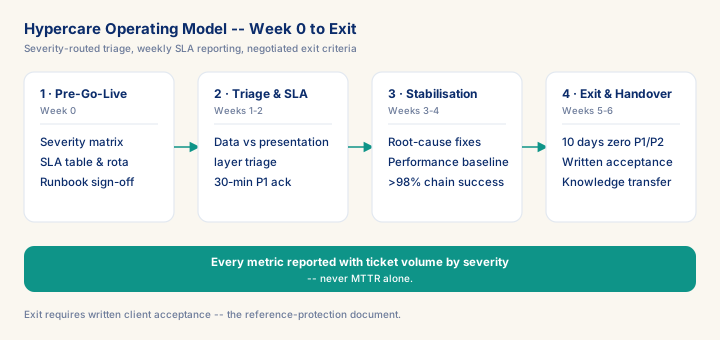
NPS is not decided at the steering committee -- it is decided in the six weeks after go-live, when the first Monday close hits a slow BW query and the on-call analyst either resolves it in two hours or lets it drift into a P1 escalation. This module builds the hypercare operating model that must be live before cutover: a four-level severity matrix, SLA tiers (30-minute P1 acknowledgement, 4-hour resolution), and exit criteria negotiated in week one rather than week six -- typically 10 consecutive business days with zero open P1/P2. The stake is direct: a consultant who can describe a hypercare closed on a named day with a named metric commands 15-20% more in day-rate negotiation than one who claims generic 'post-go-live support' experience.
What you will learn
- Design a hypercare operating model -- severity matrix, SLA tiers, triage runbook, and on-call rota -- that is functional on go-live day, not assembled reactively
- Distinguish data-layer from presentation-layer incidents and apply the correct diagnostic and resolution path for each in a SAP Analytics Cloud or BW/4HANA environment
- Define exit criteria that are measurable, negotiated upfront, and legally defensible at project close
- Communicate hypercare performance data transparently to steering committees, identifying the difference between reassuring metrics and honest reporting
Why Hypercare Determines the Reference
Go-live is the beginning of your reputation, not the end of the project. In EMEA SAP analytics delivery, the six weeks following cutover are when everything that was imperfect in UAT becomes real: the CFO's consolidated P&L flickers on a Monday morning close, the FP&A team discovers that the BW query underpinning their Actuals-vs-Plan tile is 40% slower than the legacy BEx, and the data warehouse team in Bratislava is chasing a delta-load failure at 02:00 while the business owner in Munich is asking why the dashboard shows last week's numbers.
NPS is not set at the steering committee. It is set by how competently your team responds to those first incidents. A project that delivered on scope, on time, and within budget will still yield a lukewarm reference if hypercare is chaotic. Conversely, a project that ran three months over will sometimes generate a strong reference if stabilisation was visibly professional. The six-week window is that asymmetric.
The Hypercare Operating Model: What You Actually Need on Day 1
The operating model must be live before go-live, not assembled in response to the first P1. Build it in the final sprint:
Prerequisites
- Review core concepts first: C054, C058, C047
Outcomes
- Work through a realistic scenario: A BW/4HANA analytics programme for a DACH manufacturing group cuts over on a Friday.
- Recognize and avoid the anti-pattern: Every issue triaged as P1 — The rota burns out by week one and has no capacity left for a genuine P2 in week.
- Apply the module's core decision: How many severity tiers and what SLA to promise — choose Four tiers (P1-P4) with SLAs sized to the rota you actually have -- e.g.
- Track mastery with the KPI: P1 acknowledgement and resolution time.
Full module available to members. The full module adds: the decision framework · the end-to-end scenario walkthrough · the KPI scorecard · the anti-patterns · the knowledge check · the diagrams.