Datasphere Foundations
As of 2026-10-10
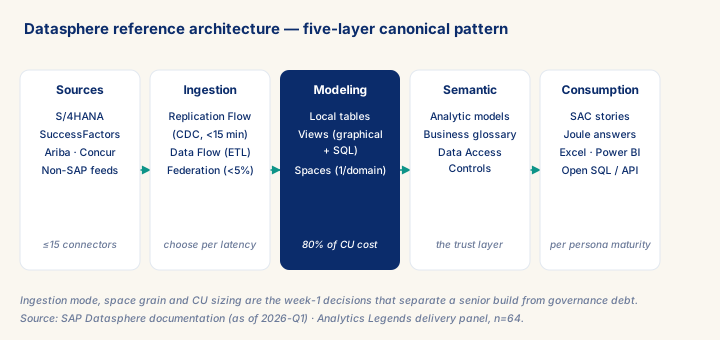
Datasphere is the five-layer cloud data fabric (Sources → Ingestion → Modeling → Semantic → Consumption) that SAP positions as the target for classic BW 7.5 estates ahead of the end of BW 7.5 mainstream maintenance (31 December 2027, paid extension to 2030); BW/4HANA itself is maintained to at least 2040. A senior foundations consultant ships one space, three analytic models, ten views, a glossary, and Data Access Controls — plus a 1-page ADR explaining trade-offs. 80 % of capacity-unit cost lives in the modeling layer; size CU there, not on source volume. Mastery places you two skills away from the €1,150-1,400/day BDC architect band.
What you will learn
- Position Datasphere against BW/4HANA, Databricks and BDC — and argue the BW 7.5 maintenance timeline (mainstream to 31 December 2027, paid extension to 2030) that drives customer demand
- Design a governed space topology (business domains + one foundation space) with one-direction cross-space contracts and scoped service accounts
- Choose the ingestion mode per source — Replication Flow, Data Flow or federation — from latency budget, cardinality and partition math
- Ship the senior 1/3/10 modeling shape (1 space, 3 analytic models, 10 views) with Data Access Controls wired on the analytic model
- Size capacity units on the modeling layer, monitor them weekly per domain, and hand over an ADR + runbook that survive the engagement
Module overview
Datasphere is SAP's cloud data fabric: the layer that turns raw S/4HANA, SuccessFactors, Ariba, Concur, and non-SAP signals into governed, semantically rich datasets that SAC, Joule, Excel, and Power BI can consume without copying data into yet another lake. The job of a Datasphere foundations consultant is to deliver a five-layer architecture — Sources, Ingestion, Modeling, Semantic, Consumption — that is correct, explainable to a non-technical sponsor, and transferable to the next consultant who inherits the engagement.
This module compresses the foundations into the decisions a senior practitioner actually makes in week one of an engagement: choose the ingestion mode per latency budget, structure spaces around governance rather than the org chart, design analytic models for the trust layer rather than for a single dashboard, and size capacity units to the modeling layer rather than to raw source volume.
Prerequisites
- Review core concepts first: C008, C006, C005
Outcomes
- Explain where Datasphere fits in the SAP data stack and defend the migration business case in front of a CFO sponsor.
- Design space topology, cross-space contracts and service-account scoping for a multi-domain enterprise customer.
- Select ingestion modes with explicit partition strategy and throughput math — and name the failure mode of each wrong choice.
- Deliver the capstone artefact set: 1 space, 3 analytic models, 10 views, glossary, Data Access Controls, ADR and handover runbook.