Datasphere Catalog & Search
As of 2026-10-10
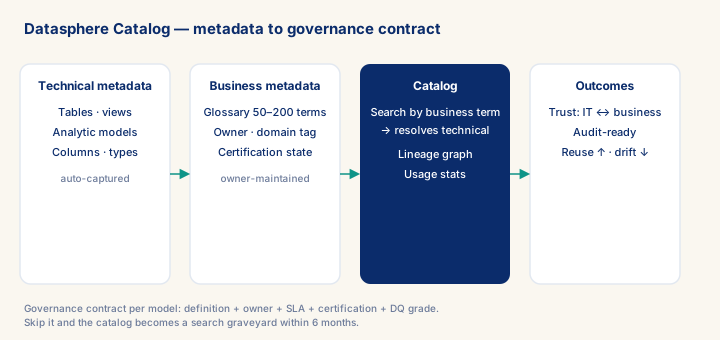
The Catalog decision that matters: tag every analytic model with five fields — business definition, owner, refresh SLA, certification state, data-quality grade — or the catalog becomes a search graveyard within 6 months. Glossary lives once, in Foundation, with 50-200 reviewed terms; per-domain glossaries drift within a quarter. Consultants who ship the governance contract, not just the search UI, leave behind a system the client team can run without them — the difference between a one-off configuration gig and a repeat engagement.
What you will learn
- Work through a realistic scenario: Multi-domain group, 4 domains, 200 datasets, no catalog discipline yet.
- Recognize and avoid the anti-pattern: Untagged AMs — Search graveyard in 6 months.
- Apply the module's core decision: Glossary location — choose Foundation space master glossary, domain extensions read-only inherit, not Per-domain glossaries (drift).
- Track mastery with the KPI: AM tagging completeness (target: 100 %; red flag: < 90 %).
Module overview
The Catalog is Datasphere's metadata search surface: the place where every dataset, view, analytic model, business term, and Joule skill in the environment becomes discoverable from one location rather than scattered across the individual memory of whoever built each artifact. A junior consultant treats the catalog as something Datasphere happens to include. A senior consultant treats it as a deliverable in its own right — one that determines whether the platform is still usable by the client's own team eighteen months after the consultant has moved on to the next engagement.
Prerequisites
- Review core concepts first: C008, C006, C005
Outcomes
- Work through a realistic scenario: Multi-domain group, 4 domains, 200 datasets, no catalog discipline yet.
- Recognize and avoid the anti-pattern: Untagged AMs — Search graveyard in 6 months.
- Apply the module's core decision: Glossary location — choose Foundation space master glossary, domain extensions read-only inherit, not Per-domain glossaries (drift).
- Track mastery with the KPI: AM tagging completeness (target: 100 %; red flag: < 90 %).
Full module available to members. The full module adds: the decision framework · the end-to-end scenario walkthrough · the KPI scorecard · the anti-patterns · the code blocks · the knowledge check · the diagrams.