
BDC Open Data Ecosystem — SAP Databricks, BDC Connect and Delta Sharing
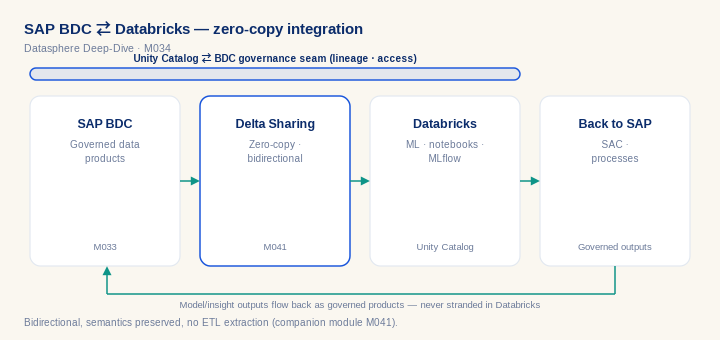
As of 2026-11-08
This course teaches the BDC open data ecosystem in the order of SAP's course BDCODE. You classify integration requests into SAP's four connection patterns, explain how a Delta Sharing read works (metadata from the sharing server, files read directly with short-lived access), provision SAP Databricks as an OEM component, share a data product into it from the cockpit and grant access in Unity Catalog. You create a BDC Connect connection by exchanging an external system identifier and an invitation link, compare what Databricks, Snowflake, BigQuery and Fabric mount, and choose replication from Datasphere only when a target cannot read a share. Deliverables: a six-request classification, a cost trace for three shares, a trial share sheet, a two-connection sheet and a route decision for four data estates. It covers topic 4 of exam C_BCBDC_2610.
What you will learn
- Classify an integration request into one of SAP's four connection patterns (data federation, data product sharing, bundled application, API) and reject BDC Connect where another pattern fits
- Trace a Delta Sharing read from the sharing server to the object store, and state where a shared BDC data product's files live and which three statuses allow the share
- Provision SAP Databricks in SAP for Me, share a data product to it with Share → Add Target, and write the Unity Catalog grants that let a team query Shares Received
- Create a BDC Connect connection by exchanging the external system identifier and the invitation link, and name the consumer object and return path for Databricks, Snowflake, BigQuery and Microsoft Fabric
- Recommend SAP Databricks, BDC Connect or Datasphere replication for a client in a decision table with costs stated only as published, and keep a connection inventory with a tested revocation
Course overview
“BDC Data Products — Install, Consume and Extend” teaches the data product round trip with SAP Databricks inside one formation. This course teaches the rest of the open data ecosystem: SAP's four connection patterns, the Delta Sharing mechanism under every zero-copy route, SAP Databricks as a provisioned component, BDC Connect to platforms the client already owns (Databricks, Snowflake, Google BigQuery, Microsoft Fabric), and the choice between them. It replaces BDC Connect: Multi-Platform and Delta Sharing in BDC, follows SAP's 56-minute course BDCODE, and adds the partner-side documentation SAP Learning does not cover.
Prerequisites
- components, formation, roles
- “BDC Data Products — Install, Consume and Extend” Lesson 3.2 (share to SAP Databricks and publish back); the 30-day BDC basic trial for Unit 4 of the workbook TRIAL_BDC_WCI
Outcomes
- Classify a "connect BDC to X" request into one of SAP's four connection patterns and into the OEM or BDC Connect family.
- Draw a Delta Sharing read (metadata call, then direct file read with pre-signed URLs or temporary credentials) and name whose compute and storage each step uses.
- Provision SAP Databricks in SAP for Me, share a data product into it from Overview > Details → Share → Add Target, and write the Unity Catalog grants.
- Create a BDC Connect connection and name, per platform, the consumer object, the return path to BDC and the source to quote.
- Recommend one of four routes with cost given only as published (CU rate not published, partner compute, egress) and a connection inventory with a tested revocation.
Full module with the Consultant plan — €19.90/month. The full module adds: the decision framework · the end-to-end scenario walkthrough · the KPI scorecard · the anti-patterns · the code blocks · the knowledge check · the diagrams.
Related guides
These guides cite this page as a source.
Open missions
32 live roles and contracts in SAP Business Data Cloud right now — see the SAP Business Data Cloud missions · freelance SAP contracts.