Hybrid Architecture Design
As of 2026-10-10
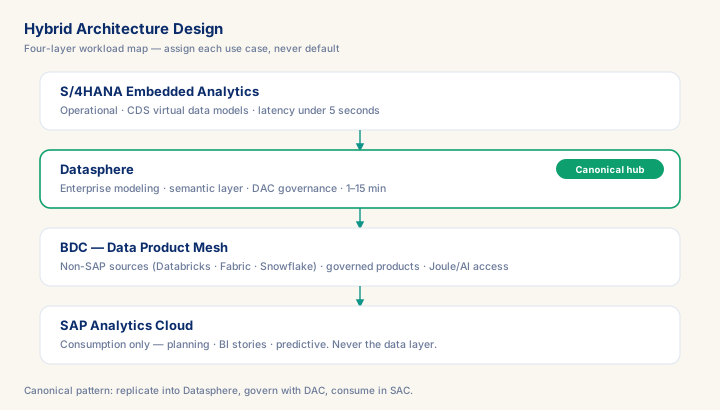
Hybrid architecture = 4 layers (S/4 embedded for sub-second, Datasphere for enterprise modeling, BDC for data product mesh + non-SAP, SAC for consumption). Three patterns: Federated Query Hub / Replication + Semantic Layer (canonical) / BDC Data Product Mesh. Five failure modes to pre-empt: latency mismatch, governance fragmentation, CU overrun, Cloud Connector bottleneck, skills gap. ADR required before architecture sign-off.
What you will learn
- Design a hybrid SAP analytics architecture — map workload types (operational reporting, enterprise analytics, data science, real-time) to the correct platform layer (S/4 embedded, Datasphere, BDC, SAC, Databricks)
- Apply the three hybrid architecture patterns (Federated Query Hub, Replication + Semantic Layer, and BDC Data Product Mesh) and select the right pattern per engagement context
- Produce an Architecture Decision Record (ADR) for a hybrid architecture choice — document drivers, constraints, options considered, decision rationale, and migration path
- Identify and mitigate the five principal hybrid architecture failure modes (latency mismatch, governance fragmentation, CU cost overrun, network bottleneck, skills gap)
Module overview
Hybrid SAP analytics architecture is not a temporary phase on the way to a "pure cloud" end state — for the overwhelming majority of enterprise clients, it is the permanent operating condition. A greenfield deployment where an organisation runs nothing but SAP Datasphere and SAP Business Data Cloud, with no legacy BW, no on-premise HANA, and no embedded S/4HANA analytics in production, is genuinely rare. Every other engagement — which is to say nearly all of them — inherits a landscape where several analytics layers coexist, each with its own strengths, its own latency profile, and its own governance model. Senior hybrid architecture is not a contest between platforms. It is the discipline of assigning each workload to the layer that serves it best, then governing the contracts at the boundaries between layers so the whole estate behaves as one coherent system rather than four uncoordinated ones.
Prerequisites
- Intermediate hands-on experience on SAP analytics projects
- Review core concepts first: C035, C033, C032
Outcomes
- Work through a realistic scenario: Belgian logistics company, S/4HANA 2023 on BTP, BW/4HANA legacy, Databricks for ML scoring, SAC, target state: BDC Data Product Mesh within 24 months.
- Recognize and avoid the anti-pattern: All use cases assigned to Datasphere by default — Operational reporting latency missed; CU wasted on sub-second use cases.
- Apply the module's core decision: S/4 embedded vs Datasphere for a reporting use case — choose S/4 embedded when latency < 5s AND data is single-system AND no cross-domain join; Datasphere otherwise.
- Track mastery with the KPI: Workload-to-layer assignment coverage (target: 100 % of use cases explicitly assigned before build; red flag: Any use case with no explicit layer assignment).
Full module available to members. The full module adds: the decision framework · the end-to-end scenario walkthrough · the KPI scorecard · the anti-patterns · the code blocks · the knowledge check · the diagrams.
Guides that answer with this page
These guides cite this page as one of the sources their answer rests on.