SLA Design for Analytics
As of 2026-10-04
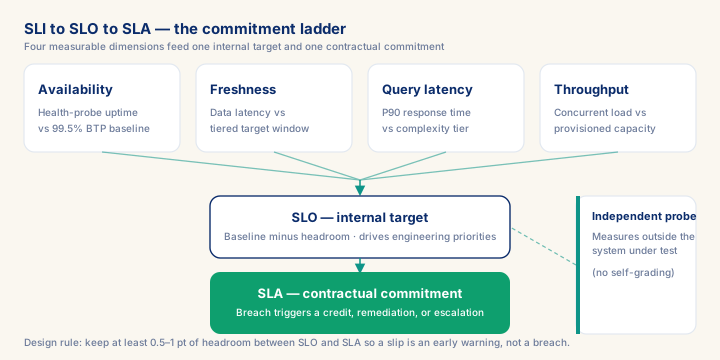
SLA design turns a vague "the dashboard feels slow" complaint into a contractual, measurable commitment — the single biggest lever for cutting escalation noise on an SAP analytics platform. The core decision is where to set the SLO-to-SLA gap: SAP's own BTP services commit to roughly 99.5% monthly availability for SAC and Datasphere, so an internal SLA set above that number is a promise the platform team cannot keep. A consultant who ships a validated SLI/SLO/SLA stack — independent measurement, per-tier freshness targets, a signed penalty structure — is doing governance work clients pay a day-rate premium for, not filling in a template. Get the SLO-to-SLA gap wrong and every month becomes a breach; get it right and the platform team has an early-warning system instead of a monthly fire drill.
What you will learn
- Define SLI, SLO, and SLA for an SAP analytics platform, and size the gap between them correctly.
- Choose the right SLI per dimension — availability, freshness, latency, throughput — for a real SAC, Datasphere, or HANA Cloud stack.
- Design an independent measurement setup so the platform never grades its own homework.
- Negotiate a penalty structure and escalation path a business sponsor will actually sign.
SLA Design for SAP Analytics Platforms
The most common SLA failure in analytics is not a breach of a commitment — it is the absence of any commitment. When an analytics platform operates without defined SLAs, every user has an implicit expectation based on their best recent experience. When actual performance falls below that expectation, the business experiences it as a failure even if engineering considers it acceptable. SLA design replaces implicit, inconsistent expectations with explicit, measurable, agreed commitments — and then builds the measurement and enforcement infrastructure to make those commitments real.
The Three-Tier Framework: SLI, SLO, SLA
Service Level Indicators (SLIs) are the specific, measurable signals that reflect system behaviour. An SLI is a ratio: the count of good events divided by the count of total events over a measurement window. For an analytics platform, SLIs must be chosen with care — they should reflect the user experience, not internal system health metrics. CPU utilisation of a HANA Cloud instance is not an SLI; query response time, as experienced by the user, is.
Prerequisites
- Review core concepts first: C038, C041, C040
Outcomes
- Work through a realistic scenario: A European retail group's finance and merchandising teams keep saying SAC dashboards "feel slow" and Datasphere's overnight loads "sometimes don't show up".
- Recognize and avoid the anti-pattern: SLA set at or above current performance — Guarantees near-constant contractual breach and trains business stakeholders to ignore SLA reports entirely.
- Apply the module's core decision: Where to set the SLO-to-SLA gap — choose Set the SLO below the measured baseline, and the SLA at least 0.5-1 point below the SLO.
- Track mastery with the KPI: SLO-to-SLA headroom (target: >= 0.5-1 point gap maintained on every SLI; red flag: The gap collapses to zero — every SLO miss becomes a contractual breach).
Full module available to members. The full module adds: the decision framework · the end-to-end scenario walkthrough · the KPI scorecard · the anti-patterns · the code blocks · the knowledge check · the diagrams.