
Insurance Analytics
As of 2026-11-07
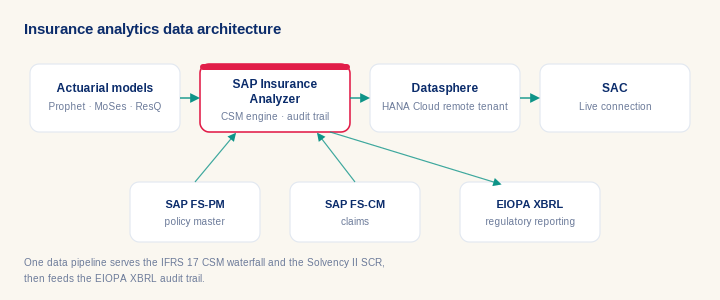
IFRS 17 replaced IFRS 4 for all annual periods from 2023, and the Contractual Service Margin (CSM) waterfall it requires is the analytical output every insurance CFO now opens the close meeting with. The consultant who can build that waterfall on SAP's IFRS 17 subledger (FPSL; SAP Insurance Analyzer in older landscapes) — cohort by cohort, reconciled to the actuarial model — can save an insurer many months versus a custom build (18-24 months is a practitioner estimate, not a published SAP figure). The scarce skill is not the SAP configuration; it is explaining, cohort by cohort, why the CSM moved.
What you will learn
- Explain how IFRS 17's CSM waterfall (from the SAP IFRS 17 subledger — FPSL; Insurance Analyzer in older landscapes) and Solvency II's SCR (from the actuarial model via the regulatory reporting module) reconcile to the same SAP financial position.
- Bridge an actuarial model's cohort and CSM output into the subledger's contract-group schema without breaking audit traceability.
- Recognise the five most common IFRS 17 and Solvency II reporting mistakes and how to avoid them.
- Position IFRS 17 / Solvency II data-lineage expertise in the rate conversation for a financial-services SAP engagement.
Module overview
Insurance analytics on SAP sits at the junction of two data models that rarely meet cleanly: the actuarial reserve model (Solvency II technical provisions, IFRS 17 CSM balances) and the operational SAP data model (policy master in SAP Financial Services for Insurance, claims in SAP Claims Management, reinsurance treaties in SAP Reinsurance Management). The consultant's job is to make them meet — and to do so in a way that closes the statutory reporting cycle without a last-minute Excel reconciliation. The two legal anchors are the Solvency II Directive 2009/138/EC (https://eur-lex.europa.eu/eli/dir/2009/138/oj) and IFRS 17 (https://www.ifrs.org/issued-standards/list-of-standards/ifrs-17-insurance-contracts/).
Prerequisites
- Intermediate hands-on experience on SAP analytics projects
- Review core concepts first: C087, C083, C046
Outcomes
- Work through a realistic scenario: A mid-size European life insurer is replacing its IFRS 17 transition-year spreadsheet CSM model with a productised SAP IFRS 17 subledger build (FPSL) ahead of its next annual close.
- Recognise and avoid the anti-pattern: Building the IFRS 17 CSM report in SAC free-form instead of inheriting the subledger's delivered views — The contract-group key is lost, and weeks are spent rebuilding what SAP already delivered.
- Apply the module's core decision: SAP's IFRS 17 subledger (FPSL; Insurance Analyzer in older landscapes) vs. a custom BW/Datasphere build — choose: Default to SAP's IFRS 17 subledger (FPSL) for a first-time build — its delivered cohort-grouping logic, CSM amortisation engine and audit-trail infrastructure save many months versus a custom build (practitioner estimate: 18-24 months); avoid: Building a custom BW/Datasphere CSM model before the actuarial output schema is stable — you rebuild the mapping every time the actuary changes a cohort definition.
- Track mastery with the KPI: CSM waterfall reconciliation break (target: No unexplained variance per contract group per quarter, beyond rounding; red flag: Any unexplained variance above rounding tolerance — this is the auditor's first test point).
Full module with the Consultant plan — €19.90/month. The full module adds: the decision framework · the end-to-end scenario walkthrough · the KPI scorecard · the anti-patterns · the code blocks · the knowledge check · the diagrams.