Public Sector Analytics
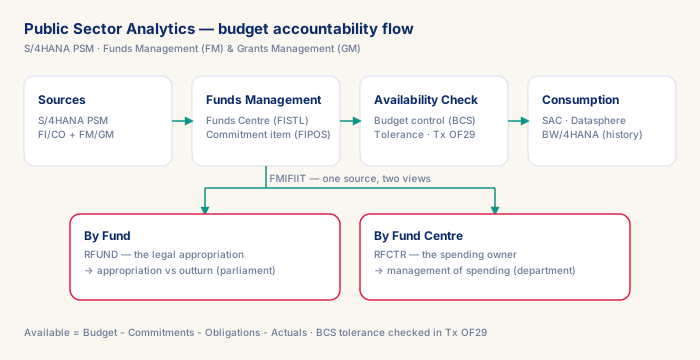
As of 2026-10-10
Public Sector Analytics is not commercial FP&A with a government logo: SAP S/4HANA PSM adds a Funds Management layer — Funds Centre, Commitment Item, Budget Availability Control — that has no commercial equivalent, and a report that aggregates it at the wrong hierarchy node gets rejected by the audit office, not just queried twice. The number that matters: on an €850M regional budget with 240 funds-centre/commitment-item lines, a live SAC-to-PSM availability check resolves in 3-8 seconds — fast enough for monthly reporting, too slow for daily operational drill-down, which is the build-vs-replicate decision every engagement hits in week one. Few SAP practitioners combine the FM/GM skill with GDPR public-task and data-residency literacy, which is why this track carries a rate premium over generic FI/CO work and produces longer, stickier contracts once the incumbent relationship is established.
What you will learn
- Work through a realistic scenario: A French conseil régional with an €850M annual budget across 240 funds-centre/commitment-item lines needs monthly budget-vs-actual reporting for its budget committee.
- Recognize and avoid the anti-pattern: Aggregating at the wrong Funds Centre node — The report misstates budget vs actual against the parliament's voted appropriation.
- Apply the module's core decision: SAC live connection vs BW/4HANA or Datasphere replication — choose A live SAC-to-PSM connection for monthly budget-line management reporting.
- Track mastery with the KPI: Budget-line false-breach rate (target: 0 of the 240 lines flagged red when they sit inside the BCS tolerance; red flag: Any false breach reaching the budget committee).
Module overview
Public sector analytics on SAP differs from commercial analytics in one fundamental way: the objective is not profit optimisation but programme performance and resource allocation under statutory constraints. The client is a ministry, a regional government, an NHS trust, or a public-sector agency — and their reporting obligations run to parliaments, audit offices, and the public rather than to shareholders. This changes everything from the data governance model (personal data under GDPR public-task lawful basis, not consent) to the procurement rules (framework agreements, reference architectures mandated by national digital authorities) to the project approval process (GDS, DINUM, and Bundesrechenzentrum equivalents vary by country and add lead time).
Prerequisites
- Review core concepts first: C083, C087, C046
Outcomes
- Work through a realistic scenario: A French conseil régional with an €850M annual budget across 240 funds-centre/commitment-item lines needs monthly budget-vs-actual reporting for its budget committee.
- Recognize and avoid the anti-pattern: Aggregating at the wrong Funds Centre node — The report misstates budget vs actual against the parliament's voted appropriation.
- Apply the module's core decision: SAC live connection vs BW/4HANA or Datasphere replication — choose A live SAC-to-PSM connection for monthly budget-line management reporting.
- Track mastery with the KPI: Budget-line false-breach rate (target: 0 of the 240 lines flagged red when they sit inside the BCS tolerance; red flag: Any false breach reaching the budget committee).
Full module available to members. The full module adds: the decision framework · the end-to-end scenario walkthrough · the KPI scorecard · the anti-patterns · the code blocks · the knowledge check · the diagrams.