
CDC & Change Data Capture
As of 2026-11-08
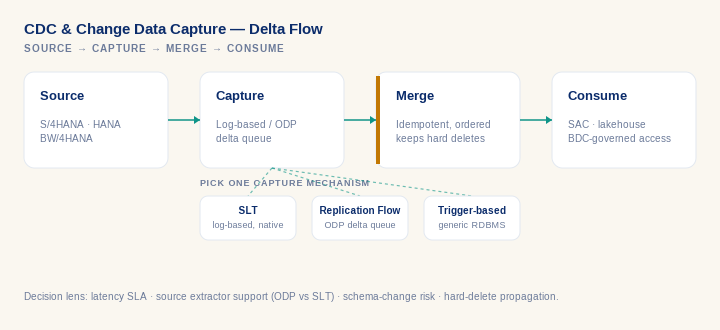
CDC & Change Data Capture decides whether a finance or logistics dashboard refreshes every 15 minutes or once a day — and whether the extraction load ever threatens HANA's own transactional workload. On a 900-million-row ACDOCA table, a full nightly load takes about 4.5 hours in this module's worked example (an assumption, not a measurement); the same delta lands within seconds via SLT, or at the delta load frequency of a Datasphere replication flow (15 minutes in the worked example). The module gives the architect a defensible way to choose between SLT, Replication Flows, and batch, to keep the target merge idempotent and correctly ordered under at-least-once delivery, and to catch drift with a same-day reconciliation control — the judgment a client steering committee expects before signing off a BW/S4 modernisation cutover.
What you will learn
- Select the right capture mechanism (SLT, Datasphere Replication Flow, or batch full load) for a given source table and latency SLA.
- Design an idempotent, correctly ordered delta-merge pattern that survives at-least-once delivery and propagates hard deletes.
- Recognise the five named CDC failure modes — log bloat, schema drift, initial-load gaps, load-type confusion (Initial Only vs Initial and Delta), currency/unit mishandling — before they reach production.
- Defend the CDC-vs-batch decision and its reconciliation control in front of a client steering committee.
CDC & Change Data Capture in the SAP Analytics Landscape
Change Data Capture (CDC) is the discipline of identifying, capturing, and delivering only the rows that changed since the last extraction — inserts, updates, and deletes — rather than re-reading an entire table on every cycle. In large SAP environments this distinction is the difference between a five-minute latency data pipeline and a six-hour batch window that consumes HANA memory, network bandwidth, and ABAP workload simultaneously. Every senior architect must be able to select the right CDC mechanism for a given SAP source, integrate it into a modern lakehouse or Datasphere landing zone, and defend that choice against the pressure to 'just do a full load every night.'
Prerequisites
- Intermediate hands-on experience on SAP analytics projects
- Review core concepts first: C005, C087, C083
Outcomes
- Work through a realistic scenario: A European manufacturing group needs an intraday P&L in SAC, refreshed every 15 minutes, sourced from a 900-million-row ACDOCA table on S/4HANA (HANA 2.0 SPS07) where a full load currently takes 4.5 hours.
- Recognise and avoid the anti-pattern: Treating a maintained timestamp column as CDC — Hard deletes vanish silently and reconciliation breaks the first time a batch job or direct SQL write bypasses the timestamp — usually discovered at month-end, not in testing.
- Apply the module's core decision: SLT vs Datasphere Replication Flow vs batch full load — choose: Default to Datasphere Replication Flows (ODP/CDS) for any S/4HANA source with an extraction-enabled CDS view — no extra server to license, native monitoring; avoid: Reaching for SLT everywhere out of habit — it adds a licensed server and ABAP/BASIS overhead that Replication Flows don't need when an ODP extractor already covers the table.
- Track mastery with the KPI: Delta-cycle latency (source commit to target availability) (target: Under 20 minutes end-to-end for a 15-minute merge SLA; red flag: Consistently exceeding the merge window — signals a log/queue backlog or an undersized merge job).
Full module with the Consultant plan — €19.90/month. The full module adds: the decision framework · the end-to-end scenario walkthrough · the KPI scorecard · the anti-patterns · the code blocks · the knowledge check · the diagrams.
Related guides
These guides cite this page as a source.