
Streaming Ingestion Patterns
As of 2026-11-08
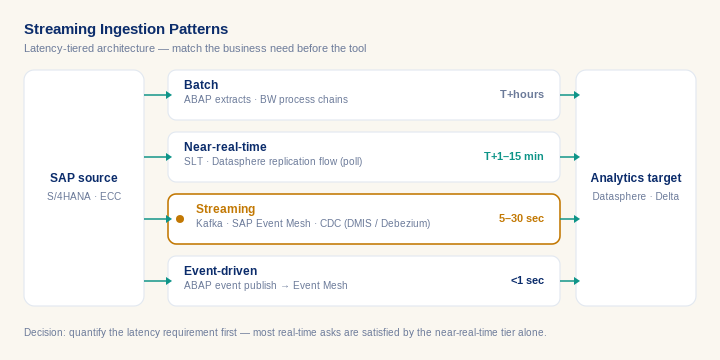
Streaming Ingestion Patterns settles the question every SAP analytics sponsor asks first: does this genuinely need Kafka, or will a 5-minute SLT lag do? Quantifying the latency requirement resolves most "real-time" requests (a project-experience estimate, not a published statistic) without touching streaming infrastructure -- the remaining share (financial risk, logistics control towers, IoT) is where sub-minute pipelines and their operational cost are justified. Consultants who can design both the SAP extraction layer (SLT, ODQ, CDS-based CDC) and the streaming layer (Kafka, schema registry, exactly-once landing) sit at a rare intersection: this profile sits at the top of EMEA freelance and salaried bands in DACH and Benelux (see the platform's day-rate benchmark).
What you will learn
- Distinguish CDC-based streaming, SLT near-real-time replication, and Datasphere replication flows -- and select the right approach per use case
- Design a Kafka-based or SAP Event Mesh integration pipeline from S/4HANA sources into a downstream analytics layer
- Evaluate latency, ordering, exactly-once semantics, and schema evolution trade-offs for SAP streaming scenarios
- Articulate streaming architecture decisions and their cost/operational implications in client workshops and rate negotiations
The Real Latency Spectrum in SAP Analytics
Before designing anything, anchor the conversation on what the business actually needs. In SAP analytics engagements the word "real-time" is systematically overspecified. A demand planner refreshing a stock overview every 30 minutes does not need sub-second latency; a trading-floor P&L dashboard fed from SAP S/4HANA Financial Accounting genuinely might. The engineering cost of reducing latency from 5 minutes to 5 seconds is disproportionate to the cost of reducing it from 5 hours to 5 minutes.
Prerequisites
- Intermediate hands-on experience on SAP analytics projects
- Review core concepts first: C035, C087, C083
Outcomes
- Work through a realistic scenario: A European discrete-manufacturing group needs sub-minute visibility into production-order status for its logistics control tower, currently fed by an overnight BW extract.
- Recognize and avoid the anti-pattern: Choosing streaming when near-real-time would satisfy the business need — The client pays for Kafka/Event Mesh staffing and operations when a 5-minute SLT lag would have been simpler and just as acceptable to the sponsor.
- Apply the module's core decision: Which latency tier to build for — choose: Default to near-real-time (SLT or a Datasphere replication flow) -- it satisfies most "real-time" asks (a project-experience estimate, not a measurement) once the latency number is quantified with the sponsor; avoid: Scoping a Kafka/Event Mesh build before the business has confirmed it actually needs sub-minute latency.
- Track mastery with the KPI: Replication lag (source commit to target availability) (target: SLT / replication flow: under 15 min p95; Kafka / Event Mesh path: under 30 sec p95; red flag: More than 2x the agreed tier target for over one business day).
Full module with the Consultant plan — €19.90/month. The full module adds: the decision framework · the end-to-end scenario walkthrough · the KPI scorecard · the anti-patterns · the code blocks · the knowledge check · the diagrams.