Dimensional Modeling Advanced
As of 2026-10-03
Dimensional Modeling Advanced is the decision that determines whether a €500M-revenue SAC report still returns in seconds at 500 million rows, or silently over-counts the moment two processes share a dimension. The stakes: a grain mismatch HANA will never flag, a materialization call that either wastes a multi-hour rebuild window or under-serves 20+ concurrent analysts, and a mixed-SCD dimension that has to stay auditable for closed-period reporting. Consultants who can defend these calls — grain boundary, junk-dimension threshold, role-playing joins, SCD type per attribute — carry Senior Architect positioning in DACH and Benelux, not implementation-analyst rates.
What you will learn
- Design a fact constellation schema for a multi-process SAP analytics landscape, making explicit grain decisions and defining data product boundaries in BDC that prevent silent cross-grain double-counting in SAC queries
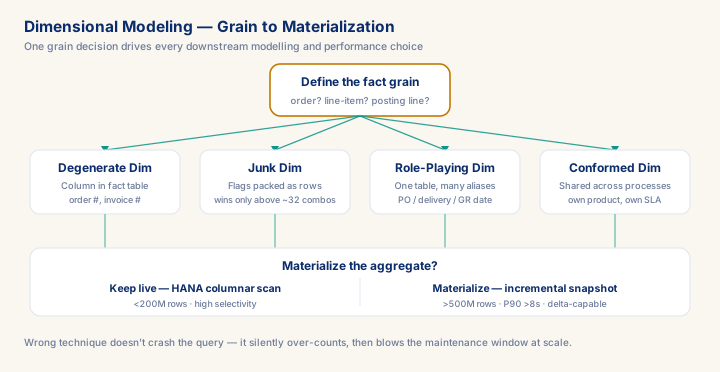
- Select and implement the correct dimensional technique (degenerate dimension, junk dimension, role-playing dimension, or conformed dimension) for a given SAP source data pattern, with justification grounded in HANA columnar performance characteristics
- Evaluate the materialisation trade-off for HANA-resident aggregate tables in Datasphere, applying P90 latency benchmarks, delta-capability constraints, and business freshness SLA to make the materialise-or-not decision
- Construct a mixed-SCD-type dimension entity in Datasphere that correctly handles Type 1 (overwrite), Type 2 (versioned surrogate key), and Type 3 (prior-value column) attributes in the same customer or organisational dimension, with a validated HANA execution plan
Beyond Star Schema Basics: What Advanced Dimensional Modelling Actually Means
Every SAP analytics consultant has been told to build a star schema. The Business Content ADSOs in BW/4HANA deliver pre-built star-compatible fact and dimension tables. SAC can read an SAP Datasphere analytic model that wraps a star. But the consultants who command the highest fees and lead the most successful migrations are the ones who understand when the textbook star schema fails, why it fails, and which of the advanced modelling techniques resolve the failure while preserving query performance on HANA's columnar engine and SAC's in-memory calculation layer.
This module addresses the gap between "I know what a star schema is" and "I can model a €500M revenue stream with thirty analysts on SAC without the report timing out."
Galaxy Schemas, Fact Constellations, and the BDC Data Product Boundary
A fact constellation (or galaxy schema) is a set of fact tables sharing common dimension tables. In a BW/4HANA or Datasphere context, this appears when multiple business processes (Sales, Finance, Procurement) share a common customer dimension or a common calendar. The modelling decision: share the physical dimension table or maintain process-specific dimension grains?
Prerequisites
- Intermediate hands-on experience on SAP analytics projects
- Review core concepts first: C087, C083, C047
Outcomes
- Work through a realistic scenario: A European industrial-equipment group is consolidating Sales, Finance, and Procurement reporting from three legacy BW systems into one Datasphere landscape feeding SAC.
- Recognize and avoid the anti-pattern: Declaring the fact grain as 'order' when the source is actually line-item.
- Apply the module's core decision: Grain sharing across process domains (Sales, Finance, Procurement) — choose Publish the shared dimension as its own governed data product with its own SLA.
- Track mastery with the KPI: Cross-fact over-count incidents (target: Zero per quarter; red flag: Any incident traced to a grain mismatch that reached a business report before being caught).
Full module available to members. The full module adds: the decision framework · the end-to-end scenario walkthrough · the KPI scorecard · the anti-patterns · the code blocks · the knowledge check · the diagrams.