Data Mesh in SAP Context
As of 2026-10-10
Data mesh promises to fix the central-team bottleneck that stalls most SAP analytics programs — but on an SAP estate the real question is organisational, not technical: can Procurement, Finance, and Logistics teams actually own a data product, or does the central team stay on-call by default? S/4HANA already ships over 8,000 CDS views as raw material and Datasphere Spaces already give each domain isolation; the gap is a self-serve platform (typically 3-5 dedicated engineers) and an MDG-anchored canonical key registry, without which cross-domain joins fail silently. Most SAP clients in 2026 — a central team of 10-30 people, domain teams with no data-engineering capability — are not ready for full mesh, so the defensible recommendation is a staged, mesh-inspired centralised build that borrows the ownership vocabulary now and distributes delivery later. Consultants who can diagnose that readiness gap, not just configure Spaces, sit in a narrow niche — SAP platform depth plus data engineering plus organisational-change advisory — priced at senior/expert day-rates on Global 500 multi-domain accounts.
What you will learn
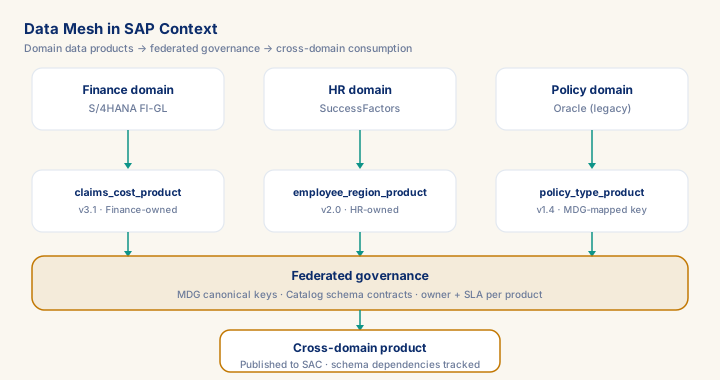
- Work through a realistic scenario: A European insurance group wants to analyse claims cost by employee region and policy type — a query that crosses Finance (S/4HANA), HR (SuccessFactors).
- Recognize and avoid the anti-pattern: Declaring mesh without distributing ownership — Datasphere Spaces get built for every domain, but the central SAP team still ships and maintains every data product.
- Apply the module's core decision: Mesh, fabric, or staged hybrid.
- Track mastery with the KPI: Domain data-product ownership coverage.
Data Mesh in the SAP Context
Data mesh is an architectural and organisational paradigm that treats data as a product, distributes data ownership to the business domain teams that understand it best, and provides a self-serve infrastructure platform so those teams can deliver, discover, and consume data independently — without routing every request through a central data team. Proposed by Z. D. in 2019, it has moved from theoretical provocation to production reality in a subset of large enterprises. For SAP practitioners, it raises a specific and honest question: what does data mesh actually mean for an SAP estate, and what organisational pre-conditions determine whether it can work?
The four principles and their SAP translation
Principle 1 — Domain-oriented decentralised data ownership.
In a data mesh, the team that owns a business domain — the Procurement domain, the Finance domain, the Logistics domain — also owns the data that domain produces, including its quality, its schema, its documentation, and its SLA. In a classic centralised data warehouse architecture, the central BI team owns all data products. In mesh, ownership is distributed.
Prerequisites
- Intermediate hands-on experience on SAP analytics projects
- Review core concepts first: C090, C008, C087
Outcomes
- Work through a realistic scenario: A European insurance group wants to analyse claims cost by employee region and policy type — a query that crosses Finance (S/4HANA), HR (SuccessFactors).
- Recognize and avoid the anti-pattern: Declaring mesh without distributing ownership — Datasphere Spaces get built for every domain, but the central SAP team still ships and maintains every data product.
- Apply the module's core decision: Mesh, fabric, or staged hybrid.
- Track mastery with the KPI: Domain data-product ownership coverage.
Full module available to members. The full module adds: the decision framework · the end-to-end scenario walkthrough · the KPI scorecard · the anti-patterns · the code blocks · the knowledge check · the diagrams.