Medallion Architecture
As of 2026-10-10
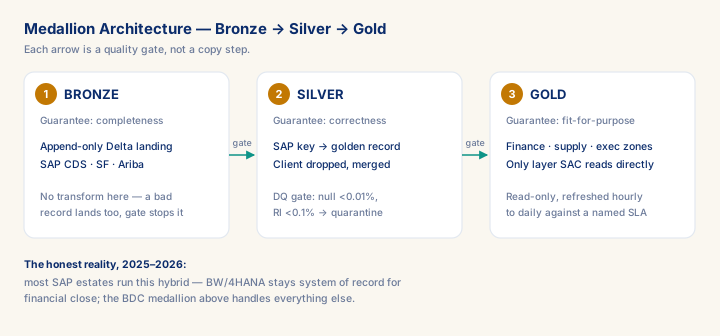
Medallion architecture turns a lakehouse into three explicit quality contracts — bronze guarantees completeness, silver guarantees correctness, gold guarantees fitness for the consumer — and inside SAP Business Data Cloud these contracts now sit directly under S/4HANA. The decision that matters in 2025-2026: most SAP estates are hybrid, running BW/4HANA DSO layering for financial close reporting alongside a BDC medallion build for everything semi-structured or ML-driven, and the consultant who can design that coexistence boundary is scarce. The number a client will hold you to: a silver referential-integrity failure rate above 0.1% should stop a promotion cold — get that gate wrong and the CFO's dashboard disagrees with the accountant's GL report. Fluency across both worlds — SAP data modelling and Delta Lake/Unity Catalog governance — is one of the few pairings the market keeps paying a premium for through the rest of the decade.
What you will learn
- Map bronze/silver/gold quality guarantees — completeness, correctness, fitness-for-purpose — onto the SAP + BDC stack, from S/4HANA CDS extraction to Unity Catalog governance.
- Decide when medallion beats BW/4HANA DSO layering, and when the honest answer is a hybrid coexistence design.
- Name the five most common medallion failure modes in SAP landscapes and the fix for each.
- Design a silver promotion quality gate — null-rate, referential-integrity, and schema-version thresholds — that a client can audit.
Medallion Architecture — Bronze, Silver, Gold in the SAP Context
The medallion architecture is a layered data refinement pattern that organises a lakehouse into three progressively cleaner zones: bronze (raw ingestion), silver (conformed and validated), and gold (business-ready, consumption-optimised). Popularised by Databricks, it has become the dominant structural idiom in modern data engineering — and with Databricks now embedded inside SAP Business Data Cloud (BDC), it is no longer an external concept for SAP practitioners. It is the load-bearing frame of the platform.
Prerequisites
- Intermediate hands-on experience on SAP analytics projects
- Review core concepts first: C035, C087, C083
Outcomes
- Work through a realistic scenario: A European manufacturing group is migrating P&L reporting from BW/4HANA to SAP Business Data Cloud without letting the CFO's numbers drift during the transition.
- Recognize and avoid the anti-pattern: Medallion-as-folder-structure — Three storage directories named bronze/silver/gold with no schema contract, promotion gate, or lineage tracking — data of different ages.
- Apply the module's core decision: Medallion lakehouse vs BW/4HANA DSO layering — choose Medallion on BDC/Databricks when ML workloads, semi-structured sources, or a BW-exit programme are in scope.
- Track mastery with the KPI: Silver referential-integrity failure rate (target: < 0.1%; red flag: Any promotion pushed through on a "we'll fix it later" basis).
Full module available to members. The full module adds: the decision framework · the end-to-end scenario walkthrough · the KPI scorecard · the anti-patterns · the code blocks · the knowledge check · the diagrams.