Lakehouse Patterns
As of 2026-10-03
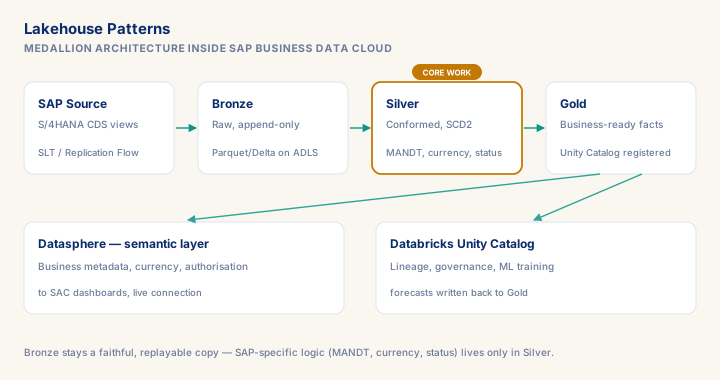
Lakehouse Patterns settles the one architecture question every SAP Business Data Cloud (BDC) engagement hits in week one: does Databricks or Datasphere own governance, and where does SAP-specific logic — MANDT filtering, currency conversion, status decoding — actually live. Get the medallion boundary wrong (business logic in bronze instead of silver) and the client re-extracts from SAP every time a rule changes; get the BDC pattern wrong and Unity Catalog authorisation drifts from SAP's profit-centre model. The economics are concrete: Databricks on Delta runs roughly 4-6x cheaper than HANA Cloud in-memory for cold historical volumes above 5-50 TB, and architects who own the full stack — SAP extraction, Delta Live Tables, Unity Catalog, Datasphere semantic reconnection — bill at 900-1,200 EUR/day freelance in DACH and Benelux. This module gives the decision frame, not a product tour.
What you will learn
- Explain the medallion (bronze-silver-gold) architecture and where it differs from a classic EDW star schema
- Design a lakehouse integration for SAP sources using BDC + Databricks or Datasphere's lake layer
- Choose between lakehouse and EDW approaches based on workload characteristics and governance constraints
- Articulate the architectural trade-offs in client conversations and salary or rate negotiations
What a Lakehouse Actually Is (and Isn't)
The term "lakehouse" is overloaded. In the SAP context it means two distinct things depending on which SAP product you are standing in, and conflating them in a client conversation is an immediate credibility risk.
The Databricks/Delta Lake meaning -- open-format columnar storage (Delta, Iceberg, or Hudi) sitting on cheap object storage (ADLS Gen2, S3, GCS), with ACID transactions, schema enforcement, and a compute layer (Spark, Photon, DuckDB) that can run directly against those files without a proprietary warehouse format. A lakehouse in this sense replaces both the staging area and the data warehouse in a single physical tier, eliminating the ETL hop from lake to warehouse.
The SAP BDC meaning -- Business Data Cloud (GA 2025) packages Databricks as a first-class compute and storage tier alongside SAP Datasphere. Within BDC, the Databricks lakehouse is the open-format foundation; SAP Datasphere sits above it providing governed semantic layer, business content, and identity federation. You will encounter clients who have bought BDC but have not yet decided which workloads live in Databricks vs. Datasphere.
Prerequisites
- Intermediate hands-on experience on SAP analytics projects
- Review core concepts first: C035, C016, C087
Outcomes
- Work through a realistic scenario: A tier-1 automotive supplier on S/4HANA 2023 (RISE) needs weekly stock-on-hand visibility per plant-material-batch in SAC.
- Recognize and avoid the anti-pattern: Writing silver logic in bronze — Bronze loses idempotency — once a currency or status-decoding bug is found.
- Apply the module's core decision: Databricks-first vs. Datasphere-first BDC pattern — choose Default to Pattern 1.
- Track mastery with the KPI: Bronze-to-silver replay success (target: 100% of silver tables rebuildable from bronze without re-extracting from SAP).
Full module available to members. The full module adds: the decision framework · the end-to-end scenario walkthrough · the KPI scorecard · the anti-patterns · the code blocks · the knowledge check · the diagrams.
Guides that answer with this page
These guides cite this page as one of the sources their answer rests on.