DBT with SAP Data
As of 2026-10-05
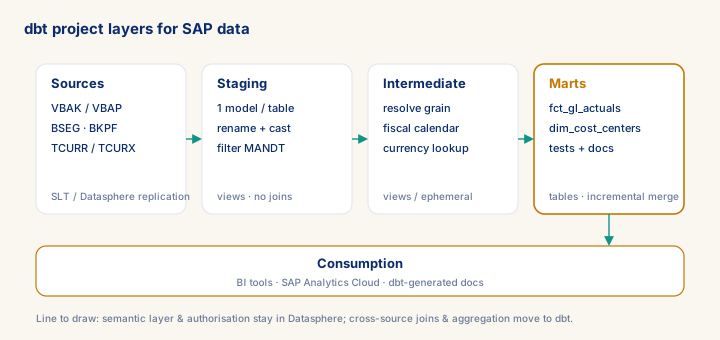
dbt has become the default transformation layer wherever Datasphere or BDC handles SAP extraction and governance but the modelling runs in Snowflake, BigQuery or Databricks. The decision that matters in week one is where to draw the line: currency rounding, unit-of-measure conversion and authorisation checks stay in Datasphere/HANA; cross-source joins, heavy aggregation and anything a non-SAP analytics engineer must maintain move to dbt. Get the SAP-specific traps wrong — MANDT left implicit, fiscal periods read with date trunc, header/item joined at the wrong grain — and the mart is quietly incorrect long before anyone notices. Engineers who can bridge both worlds bill €750-950/day in EMEA versus €550-650/day for SAP-only profiles.
What you will learn
- Build dbt projects that source, clean and model SAP-originated data inside a cloud data warehouse or Databricks lakehouse
- Design dbt model layers (staging, intermediate, mart) that respect SAP's document/header-item structure and fiscal-period logic
- Write dbt tests and generate documentation that satisfy the data-quality expectations of a SAP analytics consumer
- Evaluate when to use dbt transformations versus Datasphere-native data flows, and combine both in a hybrid architecture
Why dbt entered the SAP analytics stack
For most of the last decade, SAP analytics transformations lived inside SAP itself — ABAP transformations in BW, calculation views in HANA, data flows in Datasphere. That worked well when the data never left the SAP ecosystem. The world shifted: enterprises now run SAP as one source among many, land everything in a cloud data warehouse or a Databricks lakehouse, and expect a single transformation layer across all sources. dbt (data build tool) filled that gap, and in 2024-2025 it became the de-facto standard transformation layer in exactly the architectures where Datasphere or BDC acts as the extraction and governance tier but the heavy modelling happens in Snowflake, BigQuery, Redshift, or Databricks.
For a SAP analytics engineer this creates a concrete skill gap: you understand BW InfoObjects, Datasphere entities and HANA calculation views, but you now need to know how dbt's model-layer philosophy maps onto SAP's data structures, where the friction points are, and which transformations should stay inside SAP versus move to dbt.
Prerequisites
- Intermediate hands-on experience on SAP analytics projects
- Review core concepts first: C087, C083, C047
Outcomes
- Work through a realistic scenario: A European industrial manufacturer running S/4HANA replicates GL and sales data into Databricks via Datasphere.
- Recognize and avoid the anti-pattern: Joining header and item tables inside staging — Creates a fan-out the moment someone aggregates at header grain.
- Apply the module's core decision: Where to draw the dbt / Datasphere line — choose Keep currency translation, UoM conversion and authorisation checks in Datasphere/HANA; move cross-source joins.
- Track mastery with the KPI: dbt test pass rate on staging models.
Full module available to members. The full module adds: the decision framework · the end-to-end scenario walkthrough · the KPI scorecard · the anti-patterns · the code blocks · the knowledge check · the diagrams.
Guides that answer with this page
These guides cite this page as one of the sources their answer rests on.