Great Expectations & Data Quality
As of 2026-10-03
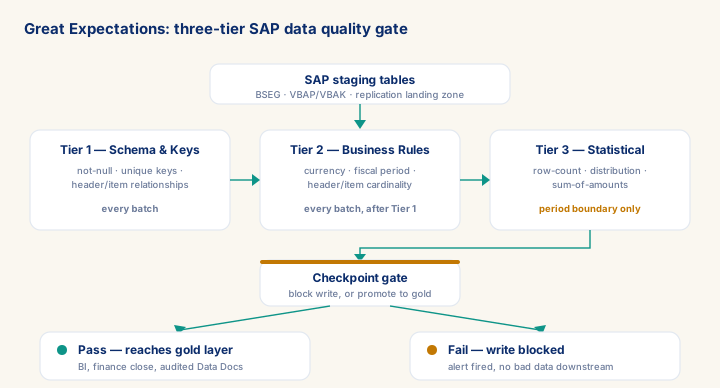
Great Expectations turns generic data-quality tooling into SAP-domain gates: expectation suites that catch MANDT contamination, orphan BSEG line items and currency-key mismatches before they reach the P&L — not just null checks. The pattern that matters commercially is a three-tier gate (schema/keys on every batch, business rules on every batch, statistical anomaly checks at period boundary) wired as a synchronous, blocking checkpoint in dbt or Databricks, never a post-mortem notification. Engineers who can show a documented GX+Databricks+Datasphere gate for GL and sales data sit in the senior/lead data-engineer bracket, billing €700-900/day in EMEA (2025-2026).
What you will learn
- Write Great Expectations expectation suites that validate the real failure modes of SAP-sourced data: key integrity, fiscal-period ranges, currency consistency and cardinality
- Integrate Great Expectations checkpoints into dbt, Databricks or Datasphere pipeline runs so data quality gates block bad data before it reaches BI consumers
- Design a data quality testing strategy that distinguishes between schema validation, business-rule validation and statistical anomaly detection for SAP analytics pipelines
- Diagnose and remediate the most common SAP data quality failures: silent replication gaps, MANDT contamination, orphan line items and currency-key mismatches
The real data quality problems in SAP analytics pipelines
SAP data quality failures are not random. They follow predictable patterns tied to SAP's architecture: silent replication gaps when the change-capture watermark misses reversals, MANDT contamination when multi-client systems are replicated without a client filter, orphan line items when header and item tables replicate at different speeds, and currency-key mismatches when WAERS is not joined before aggregation. A general-purpose data quality tool applied without knowledge of these patterns will miss the failures that actually matter while flagging noise.
Great Expectations (GX) is the most widely adopted open-source data quality framework in the modern data stack, and it integrates naturally with dbt, Spark/Databricks and Python-based orchestration. This module teaches you how to configure GX expectation suites that encode SAP-domain knowledge, not just generic schema checks.
Great Expectations concepts mapped to SAP pipelines
Expectation Suite — a named collection of expectations (assertions) about a dataset. For a SAP pipeline, you typically have one suite per staging model: stg_bseg.suite, stg_vbap.suite, fct_gl_actuals.suite. The suite is stored as a JSON artefact in a GX expectations/ directory (or in object storage for cloud deployments).
Prerequisites
- Intermediate hands-on experience on SAP analytics projects
- Review core concepts first: C041, C087, C083
Outcomes
- Work through a realistic scenario: A European discrete-manufacturing group is migrating GL and sales reporting onto Databricks, replicating BSEG and VBAP/VBAK via SAP Datasphere.
- Recognize and avoid the anti-pattern: Treating GX as a schema linter only — Only not_null and range checks run.
- Apply the module's core decision: Where to enforce the gate: dbt test vs Databricks checkpoint hook — choose Use a Databricks pre/post-hook checkpoint when bad data must never reach the gold layer.
- Track mastery with the KPI: Tier 1-2 gate pass rate (target: >= 99% of batches pass without manual override; red flag: Recurring manual overrides to push a blocked batch through — the gate is being bypassed).
Full module available to members. The full module adds: the decision framework · the end-to-end scenario walkthrough · the KPI scorecard · the anti-patterns · the code blocks · the knowledge check · the diagrams.