Future of SAP Analytics: 2030 Vision
As of 2026-10-10
By 2027, the SAP analytics question shifts from "how do we model the BW layer" to "what runs in Business Data Cloud versus Databricks, and how do governance rules propagate across both." The 20,000-30,000 classic BW 7.5 customers worldwide (SAP, Sapphire 2025) still face a forced migration decision, and the destination is increasingly Datasphere or BDC rather than a fresh BW/4HANA build. Consultants who can run the full arc — landscape assessment, BDC/Datasphere target architecture, semantic layer design for Joule — are currently commanding a 30-50% rate premium over BW specialists in EMEA freelance markets, and that gap is widening as supply stays thin. This module builds the decision frame and the learning roadmap to move from BW operator to migration architect before the premium compresses.
What you will learn
- Articulate the architectural difference between BDC as a data control plane and classic SAP analytics platforms, and explain why the Databricks partnership changes the consultant's required skill profile
- Evaluate a client's current BW/Datasphere landscape against the 2030 migration trajectory and identify where rate premium is forming for consultants who can run the full modernisation arc
- Design the semantic layer requirements that Joule needs to reason correctly over an Analytic Model, distinguishing this from traditional BEx query design
- Construct a prioritised 24-month personal learning roadmap that distinguishes GA capabilities from announced roadmap features and avoids the three common positioning mistakes
The BDC/Databricks Convergence and What It Actually Means
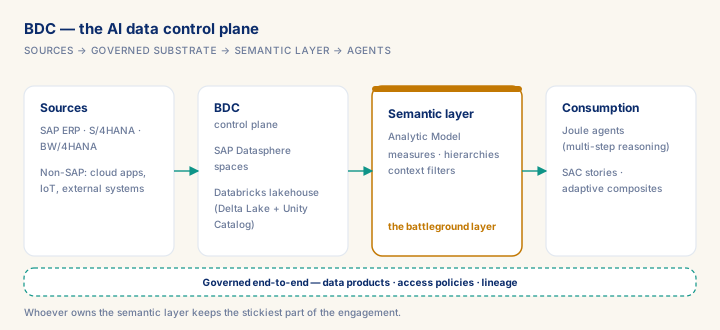
SAP's most consequential strategic bet of the decade is not a product — it is an architecture. Business Data Cloud (BDC) is SAP's attempt to become the AI data control plane for enterprise SAP landscapes: a single governed substrate through which all SAP data, all non-SAP data, and all AI agents flow before reaching any analytical or operational surface. The partnership with Databricks — announced in February 2025 with SAP Business Data Cloud (SAP Databricks) — is central to this architecture. SAP is not building a lakehouse from scratch; it is embedding Databricks' open lakehouse runtime inside BDC, meaning that the Delta Lake format and the Databricks Unity Catalog become native citizens of the SAP data estate.
Prerequisites
- Intermediate hands-on experience on SAP analytics projects
- Review core concepts first: C033, C087, C083
Outcomes
- Work through a realistic scenario: A European industrial-equipment manufacturer runs BW/4HANA for group financial consolidation and sits inside the ECC/BW migration window.
- Recognize and avoid the anti-pattern: Treating BDC as "Datasphere with a new logo" — Underbids the identity-federation, Delta Lake, and Unity-Catalog-vs-Space governance work, then overruns on delivery.
- Apply the module's core decision: BDC-first vs. Datasphere-only target architecture — choose Scope BDC when non-SAP lakehouse workloads already exist.
- Track mastery with the KPI: GA-verification discipline (target: 100% of proposed features confirmed GA on the client's release before entering scope).
Full module available to members. The full module adds: the decision framework · the end-to-end scenario walkthrough · the KPI scorecard · the anti-patterns · the code blocks · the knowledge check · the diagrams.