Non-Compete & Exclusivity Clauses
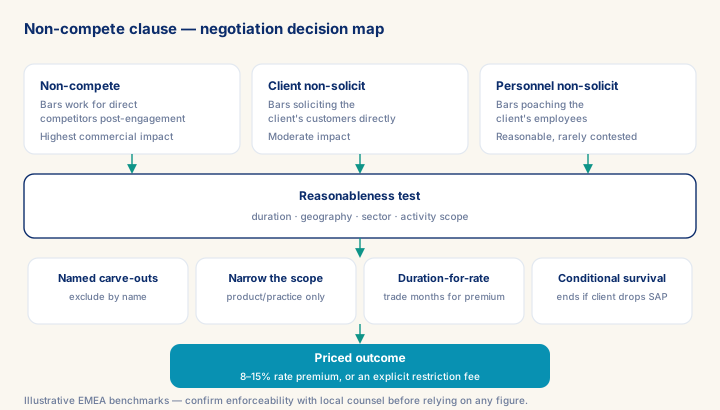
As of 2026-10-03
A bundled "non-compete" clause in a consulting MSA is usually three different restrictions — non-compete, client non-solicitation, personnel non-solicitation — with very different enforceability and very different costs to your business. Signed as one block, a broad non-compete can lock you out of 30-50% of the work in a concentrated specialist market for six to twelve months. Negotiated well, the same clause narrows to your actual sector and geography, and the restriction gets priced: an 8-15% rate premium or an explicit restriction fee. The decision that matters: never accept a meaningful non-compete at the same rate as an unrestricted engagement.
What you will learn
- Distinguish between non-compete, client non-solicitation, and personnel non-solicitation clauses and state the typical enforceability standard for each in at least two EMEA jurisdictions.
- Apply the four-dimension reasonableness test — duration, geographic scope, sector scope, activity scope — to evaluate whether a non-compete clause in a consulting MSA is proportionate.
- Use at least two negotiation techniques — named carve-outs, product-area narrowing, duration-for-rate trade, or conditional survival — to reduce a broad non-compete to a proportionate restriction.
- Calculate the approximate optionality cost of a non-compete in a concentrated specialist market and use that figure to justify a rate premium or restriction fee.
The Clause That Can Cage Your Career
Non-compete and non-solicitation clauses are among the most misunderstood provisions in consulting agreements — and among the most consequential for independent SAP analytics consultants. Signed without scrutiny, they can legally prevent you from working in your own specialist market for one to two years. Pushed back on intelligently, they can be narrowed to something that protects a legitimate client interest without limiting your livelihood.
This is practitioner guidance, not legal advice. Enforceability of non-compete clauses varies dramatically across EMEA jurisdictions. Germany's Federal Labour Court (BAG) applies strict reasonableness tests and typically requires compensation during the restriction period for employment contracts (though independent contractor non-competes operate under different rules). France has a body of case law that makes broad non-competes between businesses very difficult to enforce in practice. The UK post-Brexit maintains its own common law "reasonableness" test. Get local legal advice for any clause with a duration over six months or a geographic scope covering your primary markets.
Three Types of Clause — and What Each Actually Restricts
Most consulting agreements bundle together three distinct concepts that have meaningfully different commercial implications. Know which you are signing.
Prerequisites
- Review core concepts first: C061, C098, C070
Outcomes
- Understand the 4 legal conditions for non-compete enforceability.
- Negotiate scope, duration, geography, and financial counterpart.
- Apply the module's core decision: Which clause type are you actually signing — choose Split the three explicitly.
- Track mastery with the KPI: Clause unbundling (target: 100% of restrictive-covenant sections split into non-compete / client non-solicit / personnel non-solicit before signature).
Full module available to members. The full module adds: the decision framework · the end-to-end scenario walkthrough · the KPI scorecard · the anti-patterns · the knowledge check · the diagrams.