NDAs & Confidentiality: What to Accept, What to Refuse
As of 2026-10-03
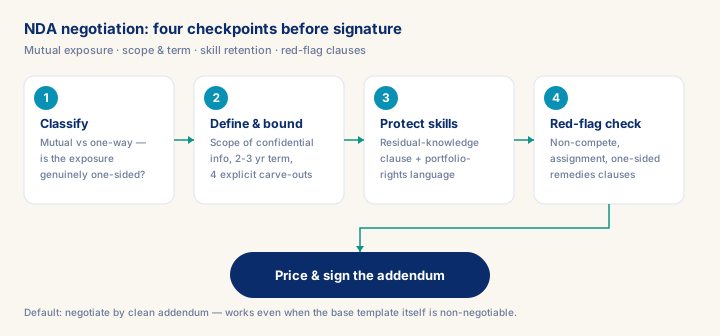
Every SAP analytics engagement worth more than a few weeks starts with an NDA, and most consultants sign it unread, then discover mid-project that they cannot pitch an adjacent client, name the engagement on LinkedIn, or reuse a technique they built. The decision that matters: push for a mutual NDA with a bounded confidentiality term, 2-3 years for ordinary business information rather than perpetual, and an explicit residual-knowledge clause, without which a modelling technique from one BW/4HANA migration is technically off-limits on your next mandate. Big Four and hyperscaler templates are rarely negotiable line by line, but a clean addendum covering mutuality, residual knowledge, and portfolio rights is usually accepted when raised at statement-of-work stage, never after signature. Restrictive post-termination terms, 18 months of non-solicitation or a sector non-compete, carry real economic value the client is extracting from you; price it into the day rate instead of absorbing it. Get this wrong once and it costs a reference, a case study, or a client relationship for years; get it right and it costs one paragraph of pushback.
What you will learn
- Distinguish mutual from one-way NDAs and identify when to push for mutuality or decline a one-sided instrument
- Negotiate residual-knowledge clauses, portfolio-rights language, and carve-outs that protect your ability to develop and demonstrate skills across clients
- Identify the five red-flag clauses most commonly embedded in corporate NDA templates that warrant pushback or escalation
- Apply a structured post-project obligations checklist covering term, destruction of materials, and the economic case for pricing unusually restrictive terms into your day rate
What You Are Actually Signing
Most SAP analytics consultants sign NDAs without reading them — then discover six months into a project that they cannot pitch a closely related client, discuss a methodology they developed, or list the engagement on their LinkedIn profile. An NDA is not bureaucratic formality. In an analytics consulting context it frequently governs your ability to reuse skills, show a portfolio, and transition between clients in the same vertical.
The first question to ask about any NDA is who drafted it and whose interests the default language serves. A hyperscaler's or global SI's standard NDA will have been reviewed by a legal team optimising for maximum protection of the signing organisation. Your interests — retaining the ability to work in your field — are not their concern. You are expected to negotiate or accept wholesale. Most consultants accept wholesale. This is a mistake on any engagement worth more than a few weeks.
Prerequisites
- Review core concepts first: C036, C063, C027
Outcomes
- Distinguish mutual vs unilateral NDAs and when to insist on mutuality.
- Negotiate a 2-3 year post-termination confidentiality window for ordinary information, reserving perpetual terms for explicitly named trade secrets.
- Identify the red-flag clauses — disguised non-compete, assignment without consent, one-sided remedies, unbounded definition, missing residual-knowledge language — before signing.
- Price unusually restrictive post-termination obligations into the day rate instead of absorbing them for free.
Full module available to members. The full module adds: the decision framework · the end-to-end scenario walkthrough · the KPI scorecard · the anti-patterns · the knowledge check · the diagrams.