Client Disputes: Amicable Recovery
As of 2026-10-06
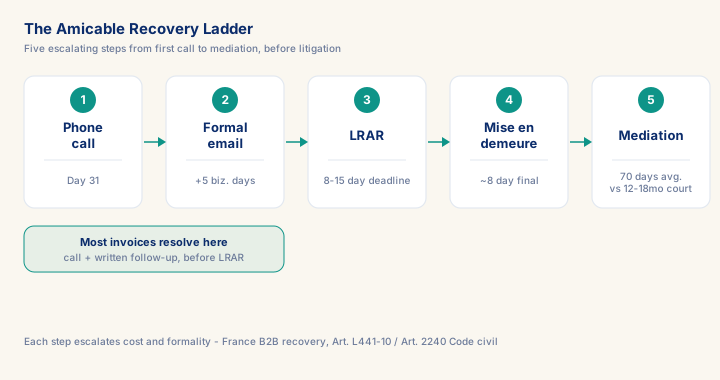
A SAP consultant's unpaid invoice is not a personality problem, it's a clock: French law gives B2B clients a 30-day default payment term, and every day past it costs roughly €135 a month in statutory interest plus a €40 indemnité forfaitaire per invoice — owed automatically, but only if you know to claim it. This module is the five-step amicable recovery ladder — phone call on day 31, formal email, LRAR, mise en demeure, then the free Médiateur des Entreprises — that resolves most invoices before a tribunal de commerce, where mediation closes in an average of 70 days against 12-18 months for litigation. The real stake is cash flow between missions: consultants who escalate predictably get paid on time; consultants who wait train clients to pay last.
What you will learn
- Calculate the legally owed amount including late-payment interest and the mandatory €40 indemnité forfaitaire per invoice
- Execute the five-step amicable recovery ladder — phone call, formal email, LRAR, mise en demeure, mediation — in correct sequence
- Draft a compliant mise en demeure citing Art. L441-10 with correct interest calculation and final deadline
- Use the Médiateur des Entreprises to resolve a B2B dispute without litigation when the amicable ladder stalls
Understanding What You Are Actually Owed
Before you pick up the phone, know what the contract says. In France, the default payment term for B2B invoices is 30 days (Art. L441-10 du Code de commerce), unless your contract stipulates otherwise — 45 days end-of-month or 60 calendar days are the legal maxima for most sectors. Public-sector clients (administration, établissements publics) are separately governed by the Décret n°2013-269, which sets a 30-day limit that is strictly enforced and carries automatic late-payment interest.
For a SAP consultant on a fixed-price mission or a régie (time-and-materials) engagement, the invoice date that triggers the clock is typically the date the services were rendered and the livrable accepted, not the date you sent the invoice. This matters because it defines when the client is legally in default.
Prerequisites
- Review core concepts first: C095, C068, C067
Outcomes
- Execute the 5-step amicable recovery sequence methodically.
- Write effective relance, LRAR, and mise en demeure letters.
- Apply the module's core decision: Call first or email first on day 31.
- Track mastery with the KPI: Days to first contact after due date (target: ≤1 day (call on day 31); red flag: No contact before day 45 — the client learns non-payment carries no consequence).
Full module available to members. The full module adds: the decision framework · the end-to-end scenario walkthrough · the KPI scorecard · the anti-patterns · the knowledge check · the diagrams.