Intellectual Property on Deliverables
As of 2026-10-04
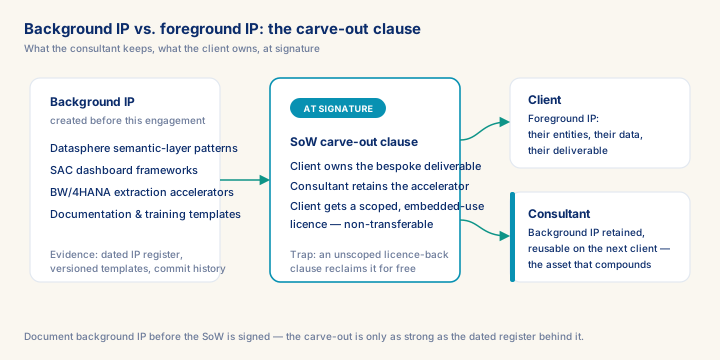
Every SAP analytics consultant accumulates reusable IP — a Datasphere modelling pattern, a SAC dashboard framework, a BW accelerator — and most give it away the first time a work-for-hire clause goes unchallenged. The single negotiating move that protects it is a background-IP carve-out: the client owns the bespoke deliverable, you retain the accelerator, and they get a scoped licence to run it in their environment. A well-documented accelerator can cut a semantic-layer build from six weeks to three — a 60% time saving that justifies a day-rate premium instead of a straight cession of the asset. Consultants who register their background IP with dated artefacts and negotiate the carve-out before the Statement of Work is signed convert an invisible efficiency into a billable, defensible line item. This module gives you the clause language, the licence-back trap to avoid, and the GDPR overlap you need before the next SoW lands on your desk.
What you will learn
- Distinguish between work-for-hire assignment and licence structures in SAP analytics consulting agreements and state when each is appropriate from the consultant's perspective.
- Identify and document background IP — pre-existing Datasphere models, SAC frameworks, BW accelerators, and documentation templates — before starting an engagement, using dated artefacts and an IP register.
- Negotiate a background IP carve-out clause that retains consultant ownership of pre-existing tools while granting the client a scoped, non-transferable licence to use them in the deliverable.
- Explain the GDPR obligations — data processing agreements, data minimisation, post-engagement purge — that arise when SAP analytics deliverables involve personal data, and ensure these are addressed in the consulting contract.
Why IP Is the Most Financially Significant Clause in an Analytics Contract
Most SAP analytics consultants underestimate the financial value of the intellectual property they create and bring to client engagements. A Datasphere semantic layer modelling pattern you have refined across eight implementations is not just a convenience — it is a productive asset that compresses what would otherwise be three weeks of modelling work to four days. That asset, if transferred to a client without carve-out, is gone. A subsequent client engagement where you would have used the same pattern now requires you to rebuild from scratch, or to accept that you are using the client's IP in another client's environment without authorisation.
IP clauses in SAP analytics consulting agreements are consequential and nuanced. Understanding them is not a legal nicety; it is financial self-preservation.
Practitioner's caveat: IP law — copyright, contract law governing assignment, and trade secret protection — varies by jurisdiction. GDPR creates additional overlapping obligations when deliverables process personal data. This module addresses the common contractual structures and practical negotiating positions; it is not legal advice. For high-value engagements where your background IP is genuinely at risk, get specialist IP legal review.
Prerequisites
- Intermediate hands-on experience on SAP analytics projects
- Review core concepts first: C041, C088, C067
Outcomes
- Distinguish work-for-hire, licensed IP, and retained IP in contracts.
- Draft IP clauses that preserve your frameworks and methodologies.
- Apply the module's core decision: Work-for-hire vs. licensed background IP — choose Accept work-for-hire on the bespoke deliverable; carve out and licence your background IP.
- Track mastery with the KPI: Background-IP schedule attached to SoW.
Full module available to members. The full module adds: the decision framework · the end-to-end scenario walkthrough · the KPI scorecard · the anti-patterns · the knowledge check · the diagrams.