Subcontracting: Tripartite Agreements
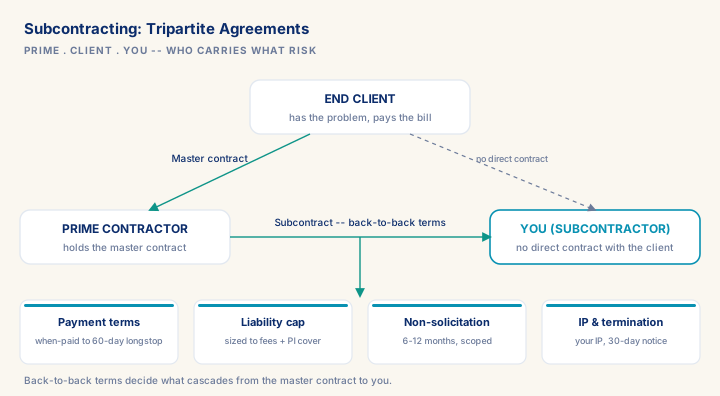
As of 2026-10-03
Subcontracting turns a day-rate mandate into a three-party risk chain: end client, prime contractor, and you. The clauses that decide whether you get paid, how much liability you carry, and whether you can ever work directly for that client again are negotiated in the subcontract, not the master contract you will probably never see. Three numbers anchor the negotiation: a 60-day longstop that kills payment-when-paid risk, a liability cap sized to your professional indemnity cover (typically 250K-2M EUR), and a non-solicitation window of 6-12 months, not 24. Get those three wrong and a well-priced day rate turns into a bad debt or a client you can never bill directly again.
What you will learn
- Map the prime/sub/client triangle and identify which contractual obligations flow to you through back-to-back terms versus those that remain the prime's risk
- Distinguish payment-when-paid from payment-upon-receipt clauses, calculate their effective impact on your working capital, and negotiate a longstop date that removes contingent payment risk
- Apply a proportionality test to liability flow-down clauses and construct a set of exclusions and caps appropriate to your scope and professional indemnity cover
- Conduct a pre-signature due diligence checklist covering scope alignment, IP ownership, non-solicitation scope and duration, termination provisions, and jurisdiction
The Triangle You Are Actually Working In
When you work as a subcontractor in an SAP analytics engagement, there are three parties: the end client (who has the business problem and pays the bill), the prime contractor (a system integrator or staffing agency who has the master contract), and you. The legal structure matters enormously because your formal contractual relationship is only with the prime — not with the client. That means when the client delays approvals, changes scope, or fails to pay the prime, the consequences can reach you through mechanisms you never negotiated.
Back-to-back terms are the mechanism by which a prime contractor passes obligations from the master contract down to you. A prime that receives a 30-day payment term from the client, a performance penalty clause, and an indemnity obligation will attempt to mirror each of those into your subcontract. The principle is sound — the prime should not assume risk they cannot control. The execution is often excessive: back-to-back terms that were acceptable for a large SI with insurance and legal resources may be commercially unreasonable for an individual consultant or a small firm.
Prerequisites
- Review core concepts first: C061, C068, C067
Outcomes
- Understand tripartite liability under French Loi Macron and payment chain.
- Demand the 6 protective clauses in every subcontracting arrangement.
- Apply the module's core decision: Payment-when-paid vs payment-upon-receipt — choose Payment-upon-receipt with a 60-day longstop: if the prime hasn't been paid within 60 days of your invoice due date.
- Track mastery with the KPI: Payment risk (target: Payment-upon-receipt with a <=60-day longstop; no pure payment-when-paid; red flag: Contingent payment with no longstop).
Full module available to members. The full module adds: the decision framework · the end-to-end scenario walkthrough · the KPI scorecard · the anti-patterns · the knowledge check · the diagrams.