Risk Registers That Actually Work
As of 2026-10-10
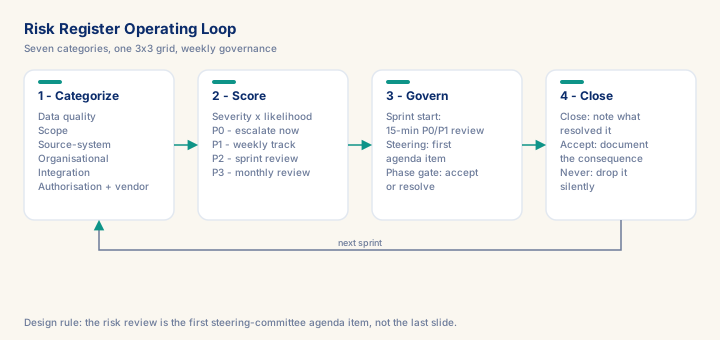
Most SAP analytics risk registers are dead documents: filled in once during Prepare, reviewed at the first steering committee, then ignored until someone needs an alibi for a delay. The fix is not a better template but seven risk categories specific to SAP analytics engagements — data quality, scope, source-system readiness, organisational, integration and scheduling, authorisation, and vendor — scored on a simple 3x3 severity-likelihood grid instead of a false-precision 25-cell matrix, and reviewed as the first agenda item at every steering committee, not the last slide. On 40% of SAP analytics projects, authorisation risk alone becomes a delivery blocker because it was treated as someone else's problem. A consultant who can show a live, specific register — not a generic one — turns a scope dispute from a blame conversation into a documented, defensible one, which is exactly what protects the day-rate premium.
What you will learn
- Build a risk register for an SAP analytics project that captures the real risk categories — data quality, scope, source-system readiness, and organisational — rather than generic project risks
- Apply a simple severity-and-likelihood scoring system that allows risk prioritisation without false precision
- Use the risk register as an active delivery tool across all six Activate phases, not as a documentation artefact
- Conduct a structured risk review with the client that builds trust rather than triggering defensive reactions
The Problem With Most Risk Registers
The risk register on most SAP analytics projects is a spreadsheet created in Prepare, reviewed once in the first steering committee, and never opened again until someone is looking for documentation to justify a delay. It contains entries like "Resource unavailability" (severity: High, likelihood: Medium, mitigation: "Ensure adequate staffing") and "Technical failure" (severity: High, likelihood: Low, mitigation: "Follow best practices"). These entries are not wrong in the sense that they are false. They are wrong in the sense that they tell you nothing about this project, could have been copied from any other project, and will not be consulted by anyone making a real decision.
A risk register that works is a living document maintained by the delivery lead, updated at the start of every sprint, and used in steering committee conversations as the primary basis for decisions about scope, timeline, and resource allocation. It contains risks that are specific, owned, tracked over time, and actionable. Building that kind of register requires understanding what the real risk categories are on an SAP analytics engagement — which are not the same as the generic project risk categories in PMBOK or your company's standard template.
Prerequisites
- Review core concepts first: C058, C047, C100
Outcomes
- Work through a realistic scenario: A European discrete-manufacturing group, four plants, six weeks into a BW/4HANA and SAP Analytics Cloud rollout.
- Recognize and avoid the anti-pattern: Delegating the register to a junior resource — Formatting gets maintained but the judgment calls — has this escalated, has it actually been mitigated — never get made.
- Apply the module's core decision: Which scoring system to use — choose 3 severity levels x 3 likelihood levels (9 cells, 4 priority bands P0-P3).
- Track mastery with the KPI: P0/P1 mitigation coverage (target: 100% of P0/P1 entries have a named owner and a target date; red flag: Any P0/P1 without an owner or date for more than one sprint).
Full module available to members. The full module adds: the decision framework · the end-to-end scenario walkthrough · the KPI scorecard · the anti-patterns · the knowledge check · the diagrams.