SAP Activate: The Methodology Beyond the Slides
As of 2026-10-06
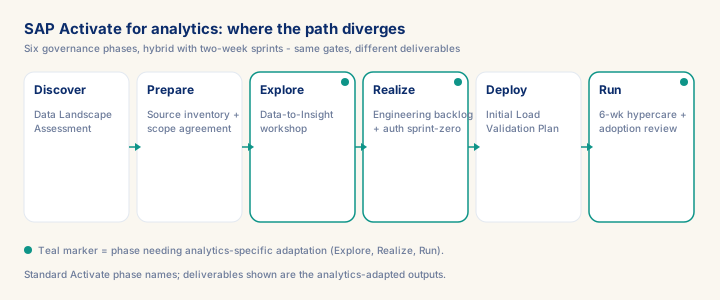
SAP Activate is not a waterfall to follow but a governance and accelerator model to adapt — and knowing exactly where analytics engagements diverge from the standard phases is what separates a certified consultant from a senior one. The two decisions that matter most: replace Fit-to-Standard workshops with a Data-to-Insight validation in Explore, and design the authorization concept in Realize sprint zero rather than at UAT — teams that leave it until the end routinely lose four to six weeks. This module maps all six phases to the real analytics delivery rhythm, from the Data Landscape Assessment in Discover to the Initial Load Validation Plan in Deploy and the six-week hypercare minimum in Run. The payoff is positioning: "I know which parts of Activate need adapting for analytics" is a materially stronger rate conversation than "I am Activate certified."
What you will learn
- Map the six SAP Activate phases onto the real delivery rhythm of an SAP analytics engagement, identifying where the methodology fits and where it must be adapted
- Apply the Activate Roadmap Viewer to locate analytics-specific accelerators for Datasphere, SAC, and BW/4HANA projects
- Identify the three phases where analytics projects most frequently diverge from standard Activate guidance and apply compensating practices
- Use Activate sprint ceremonies (backlog refinement, sprint review, retrospective) in a way that works for a business intelligence delivery context
What SAP Activate Actually Is — and Is Not
SAP Activate is a delivery framework, not a prescription. The confusion starts at the certification level: the slides show six clean phases with sequential arrows, and practitioners internalise the sequence as a waterfall. On real SAP analytics projects, the sequence is almost never clean. Understand what Activate provides — a structured accelerator library, a governance model, and a set of phase gates — and you can use it effectively. Treat it as a waterfall you must follow precisely and you will spend more time managing methodology compliance than delivering value.
Activate has three pillars. The first is the Roadmap Viewer (me.sap.com/roadmapviewer, the address SAP's current announcements use), which is the accelerator library: thousands of tasks, work packages, deliverable templates, and guided configuration documents, organised by scope item and phase. The second is the agile delivery model, which SAP built into Activate as an explicit hybrid: structured governance phases containing iterative sprints. The third is the Fit-to-Standard approach, which is SAP's instruction to start from the baseline product configuration and identify gaps rather than starting from the requirements document. All three pillars matter. Most practitioners use only one.
Prerequisites
- Review core concepts first: C058, C047, C087
Outcomes
- Work through a realistic scenario: A European industrial-equipment manufacturer is replacing a legacy BW reporting layer with SAP Datasphere and SAC ahead of an S/4HANA migration.
- Recognize and avoid the anti-pattern: Treating Fit-to-Standard as the analytics design method — Showing a standard SAC story template and asking "is this what you need?" produces a demonstration.
- Apply the module's core decision: Explore workshop format — choose Run a Data-to-Insight workshop: present the proposed data model and calculation logic.
- Track mastery with the KPI: Authorization design lead time (target: Designed and transported by the end of Realize sprint zero; red flag: Design starts during UAT).
Full module available to members. The full module adds: the decision framework · the end-to-end scenario walkthrough · the KPI scorecard · the anti-patterns · the knowledge check · the diagrams.