
The Facilitator's Craft: Workshops That Unlock
As of 2026-11-07
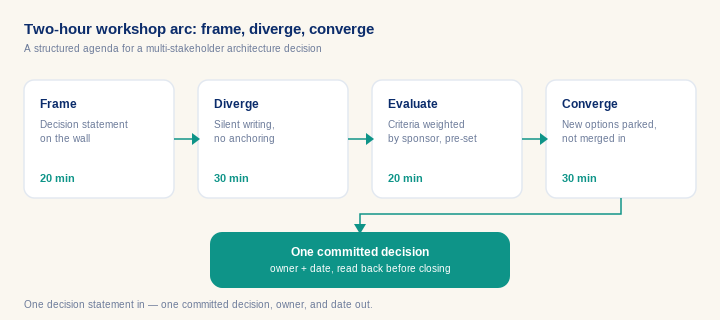
A workshop that ends without a named decision, owner, and date is a diagnostic failure, not bad luck — and it is preventable. This module gives SAP analytics consultants a two-hour diverge/converge agenda, three named techniques for the dominant voice in the room, and a five-part pre-workshop brief that removes the single largest cause of wasted workshop time: participants who arrive without knowing what they are being asked to decide. Facilitation that reliably produces a decision on the day, not a deck for the next meeting, is worth a EUR 200-400/day premium to clients who have already sat through workshops that did not converge.
What you will learn
- Design a two-hour workshop agenda with a diverge/converge structure that consistently produces one concrete decision by the end
- Apply three specific facilitation techniques for neutralising dominant voices without damaging the relationship
- Construct a pre-workshop brief that eliminates the most common cause of wasted workshop time: participants arriving with misaligned expectations
- Diagnose the four failure modes that cause SAP analytics workshops to end without a decision and correct each in real time
The diagnostic question every facilitator must answer first
Before you design a single agenda item, answer this question: what decision needs to exist at the end of this workshop that does not exist now? This is not the same as asking which topics you will cover or which outputs you will produce. A decision is specific, attributable and actionable. "The steering committee agrees that Datasphere is the right architecture" is a sentiment. "The steering committee approves the Datasphere implementation with a budget of EUR 420K, a go-live target of Q4 2026 and a named programme sponsor" is a decision (all three values are an example, not a benchmark).
If you cannot answer the question before the workshop, the workshop is not ready to run. The most expensive facilitation mistake is a 2-day design sprint with 12 senior stakeholders when the real disagreement is whether the project should exist at all. That needs a 1 h meeting with 2 decision-makers, not 12 people for 2 days.
Prerequisites
- Intermediate hands-on experience on SAP analytics projects
- Review core concepts first: C083, C079, C058
Outcomes
- Work through a realistic scenario: A European retail group's SAP analytics steering committee has been stuck for six weeks on whether to migrate reporting onto Datasphere. Two executive sponsors quietly disagree about the programme's scope, and three previous meetings produced discussion decks but no decision.
- Recognize and avoid the anti-pattern: Running the workshop before answering the decision question — Twelve senior people spend two days debating design when the real disagreement is whether the project should exist — the workshop cannot produce a decision because it is aimed at the wrong question.
- Apply the module's core decision: Workshop or one-on-one meeting? — choose: Default to a one-hour meeting with the actual decision-makers when the real disagreement is about scope or the project's existence, not about design; avoid: Booking a two-day workshop with twelve senior stakeholders to paper over a two-person conflict that a short conversation would resolve.
- Track mastery with the KPI: Decisions per workshop (target: 1 named decision — with owner and date — per 2-hour session; red flag: Zero named decisions after a half-day workshop: the agenda diverged but never converged).
Full module with the Consultant plan — €19.90/month. The full module adds: the decision framework · the end-to-end scenario walkthrough · the KPI scorecard · the anti-patterns · the knowledge check · the diagrams.