Status Reports Executives Actually Read
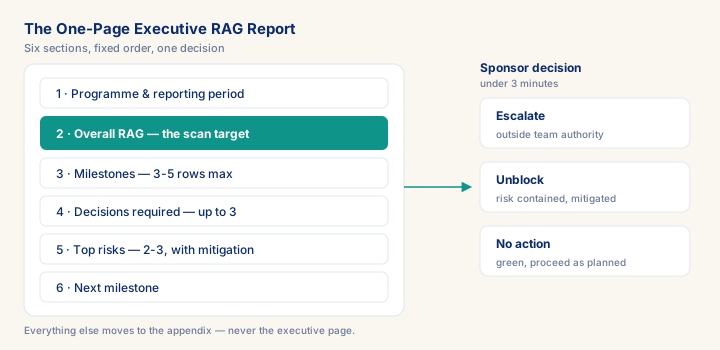
As of 2026-10-04
A weekly status report that executives don't read is not a communication problem — it is a career-limiting one. The one-page RAG report forces a single decision (escalate, unblock, or wait) in under three minutes, and the discipline that makes it work is refusing to colour amber a situation that is structurally red. Consultants who own this artefact credibly move from 'the person who builds the pipeline' to 'the person who runs the programme' — a shift worth €100-200/day on senior EMEA day-rate bands, and often the deciding factor in fixed-price bids scored on communication quality.
What you will learn
- Structure a one-page RAG executive status report for SAP analytics programmes that a sponsor can act on in under three minutes
- Apply honest RAG colour discipline — distinguishing amber from red without washing risk and without over-escalating contained issues
- Set distribution, cadence, and formatting standards that maximise the probability of the report being read and acted on
- Position executive reporting capability as a differentiating skill in client delivery and contractor rate negotiations
Why Most Status Reports Get Skipped
The 10-page weekly report has a readership problem. Programme directors at large European SI firms have documented that executive sponsors skim the first paragraph and jump to the traffic-light summary — if one exists. When it doesn't, the report goes unread or is delegated to a junior project manager who sends a one-line précis via Teams. The information you spent hours assembling reaches the decision-maker stripped of context and nuance.
The one-page RAG (Red–Amber–Green) status report is not a dumbed-down version of a full status report. It is a different artefact with a different purpose: giving a CIO, CFO, or programme sponsor enough signal to make one decision — escalate, unblock, or do nothing — in under three minutes.
This module is about building that artefact correctly for SAP analytics programmes, where the technical complexity of Datasphere pipelines, SAC story publishing chains, and BW/4HANA migration sequencing makes the temptation to over-explain almost irresistible.
The Architecture of a One-Page Executive Status Report
A single page forces brutal prioritisation, which is its core value. The structure that works across EMEA SAP analytics deliveries has six components in a fixed order.
Prerequisites
- Review core concepts first: C058, C047, C087
Outcomes
- Work through a realistic scenario: A Datasphere migration programme for a European industrial manufacturer needs a credible executive reporting cadence from week one.
- Recognize and avoid the anti-pattern: Amber-washing a structurally red situation — The sponsor trusts the signal, doesn't escalate, and the programme slips two months before anyone intervenes.
- Apply the module's core decision: RAG colour when the situation is genuinely uncertain — choose Default to amber only when the risk is isolated to one workstream and a mitigation is already scheduled.
- Track mastery with the KPI: Read-to-action rate (target: Sponsor responds to the Decisions required section within 48 hours; red flag: No response within one full cycle).
Full module available to members. The full module adds: the decision framework · the end-to-end scenario walkthrough · the KPI scorecard · the anti-patterns · the knowledge check · the diagrams.