
Clean Core Analytics
As of 2026-11-08
SAP rates every extension on four clean core levels: A (released APIs and extension points), B (classic APIs), C (internal SAP objects, no stability guarantee) and D (modifications, direct writes, state noAPI). An extension takes the level of the lowest technology it uses, so one internal-table read makes a whole extractor Level C. For analytics this decides what SAP Datasphere can read safely: extraction-enabled C1-released CDS views (CDS_EXTRACTION) and CDS view entities exposed through the ABAP SQL service (SQL_SERVICE) are the stable paths; SAPI extractors remain supported on-premise but CDS views are preferred. The module teaches the ATC / Custom Code Migration scan, the per-object compliance register and the three failure modes that break loads at the next upgrade.
What you will learn
- Rate every analytics-related custom object of an S/4HANA engagement on SAP's clean core levels A to D with the ATC or the Custom Code Migration app and the Cloudification Repository
- Choose the stable path into SAP Datasphere for each object: extraction-enabled C1-released CDS views (CDS_EXTRACTION), CDS view entities through the ABAP SQL service (SQL_SERVICE), or SAPI via ODP where it remains acceptable
- Diagnose and remediate the three failure modes — CDS views on internal tables, raw table replication, legacy SAPI extractors — with their documented symptoms
- Produce a per-object compliance register that states level, path, target and upgrade risk, and keep it current after go-live
Clean Core is how SAP rates an extension by its upgrade stability, and for an analytics architect it decides which S/4HANA objects SAP Datasphere or SAP Business Data Cloud can read safely release after release. In practice the question is narrow and checkable: does each extractor, CDS view and custom table in scope reach Datasphere through a released interface (CDS_EXTRACTION or SQL_SERVICE container in a replication flow), or through an internal object that the next upgrade can change?
Clean Core defined, for analytics specifically
SAP now rates extensions on four clean core levels. Level A uses released APIs and extension points (key user tools, developer extensibility with ABAP Cloud, side-by-side extensions on SAP BTP); Level B uses classic APIs such as wrappers around BAPIs; Level C uses internal SAP objects that SAP does not support for customer use; Level D uses not-recommended objects or patterns such as modifications or direct writes to SAP tables (state noAPI in the Cloudification Repository). The levels replace the retired 3-tier model, and an extension is rated by the lowest-ranked technology it uses — one internal table read makes a whole extractor Level C.
Prerequisites
- Intermediate hands-on experience on SAP analytics projects
- Review core concepts first: C033, C032, C035
Outcomes
- Work through a realistic scenario: RISE with SAP engagement, retail client, S/4HANA 2022 → upgrade to 2023. Analytics scope: 12 active Datasphere Replication Flows, of which 4 are custom. Clean Core certification required before upgrade sign-off.
- Recognize and avoid the anti-pattern: Skipping the clean core scan before Datasphere extraction design — Level C objects are discovered when they cannot be found in the CDS_EXTRACTION container or break at upgrade; rework lands in the build phase.
- Apply the module's core decision: Custom field extension — choose: Custom Fields app (key user, Level A) — enabled for the reports and CDS views of the business context; avoid: Appending a field to an SAP table by modification — Level D.
- Track mastery with the KPI: Custom extractor compliance rate (target: 100 % of replication flow sources in CDS_EXTRACTION, SQL_SERVICE or a documented ODP SAPI exception; red flag: A raw table or Level C extractor in an active replication flow at upgrade time).
Full module with the Consultant plan — €19.90/month. The full module adds: the decision framework · the end-to-end scenario walkthrough · the KPI scorecard · the anti-patterns · the code blocks · the knowledge check · the diagrams.
What does clean core SAP mean for analytics?
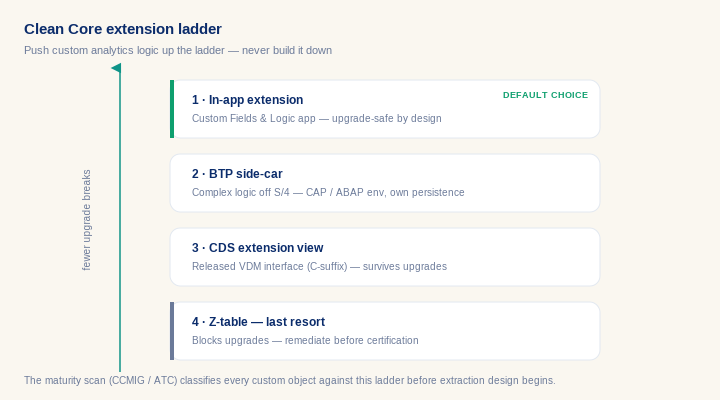
The module treats Clean Core as SAP's mandate for S/4HANA Cloud and, increasingly, a prerequisite for Datasphere or Business Data Cloud deployments that want continuous updates. For analytics it means classifying extensions: in-app extensions, BTP side-car patterns, stable CDS extension views, and non-compliant Z-table or SAPI extractors. It names three common failure modes: CDS views on internal tables, Z-tables beneath Replication Flows and SAPI extractors used as a bridge.