
Automotive & Mobility
As of 2026-11-07
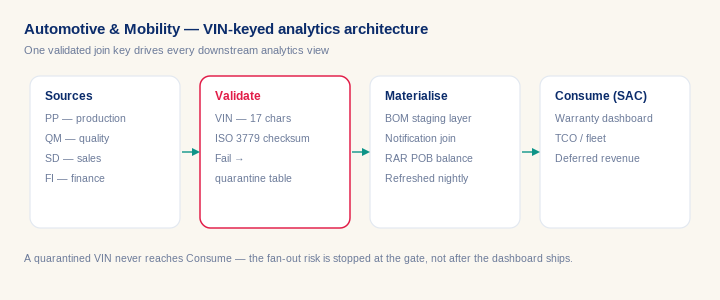
Automotive and mobility analytics on SAP is a bill-of-materials problem before it is a BI problem: a premium vehicle carries 30,000+ part numbers, and a query that explodes that BOM live will time out — the fix is a nightly-materialised BOM layer in Datasphere, the pattern that, in the module's worked example, takes a Tier-1 supplier's warranty dashboard from 45-90 seconds to under 3. The module also covers the shift most SAP shops are least ready for: connected-vehicle subscriptions recognised under IFRS 15 through SAP RAR, tracked by VIN rather than by sales order. A consultant who can join BOM, quality, and RAR data on a validated VIN — and who keeps warranty and recall cost apart — sits at the top of the industrial-analytics rate band; one who can't spends the engagement rebuilding trust in numbers finance has already stopped believing.
What you will learn
- Work through a realistic scenario: A German Tier-1 automotive supplier (€4B revenue, 800 active part numbers) needs a warranty-cost analytics platform its category managers can query daily, without hitting the S/4HANA QM tables directly.
- Recognize and avoid the anti-pattern: Exploding the BOM inside a live analytic query — Query cost climbs steeply with BOM depth; a report that returns in seconds against the materialised layer times out against live CS11/CS12 calls.
- Apply the module's core decision: Where to run BOM explosion — choose: Pre-materialise the exploded BOM nightly in a Datasphere staging layer and join analytics queries to that layer only; avoid: Calling the BOM explosion function module inside a live analytic query — cost climbs steeply with BOM depth and times out at scale.
- Track mastery with the KPI: Warranty dashboard query latency (target: Under 3 seconds for a 20-user concurrent daily review; red flag: Above 45 seconds means the query is still hitting QMEL/AUFK/MSEG live instead of the staging layer).
Module overview
Automotive and mobility analytics on SAP is shaped by two structural facts that distinguish the industry from all others: the complexity of the bill of materials (a premium vehicle has 30,000+ unique part numbers, each with a multi-level production BOM and a service BOM) and the shift from one-time product sales to recurring connected-vehicle service revenue. Both require SAP analytics capabilities that go well beyond a standard BI deployment. The EU type-approval framework, Regulation (EU) 2018/858, is the regulatory backdrop for much of the data this module touches (https://eur-lex.europa.eu/eli/reg/2018/858/oj).
Prerequisites
- Intermediate hands-on experience on SAP analytics projects
- Review core concepts first: C087, C083, C046
Outcomes
- Work through a realistic scenario: A German Tier-1 automotive supplier (€4B revenue, 800 active part numbers) needs a warranty-cost analytics platform its category managers can query daily, without hitting the S/4HANA QM tables directly.
- Recognize and avoid the anti-pattern: Exploding the BOM inside a live analytic query — Query cost climbs steeply with BOM depth; a report that returns in seconds against the materialised layer times out against live CS11/CS12 calls.
- Apply the module's core decision: Where to run BOM explosion — choose: Pre-materialise the exploded BOM nightly in a Datasphere staging layer and join analytics queries to that layer only; avoid: Calling the BOM explosion function module inside a live analytic query — cost climbs steeply with BOM depth and times out at scale.
- Track mastery with the KPI: Warranty dashboard query latency (target: Under 3 seconds for a 20-user concurrent daily review; red flag: Above 45 seconds means the query is still hitting QMEL/AUFK/MSEG live instead of the staging layer).
Full module with the Consultant plan — €19.90/month. The full module adds: the decision framework · the end-to-end scenario walkthrough · the KPI scorecard · the anti-patterns · the code blocks · the knowledge check · the diagrams.