Insurance for Self-Employed (Prévoyance & Mutuelle)
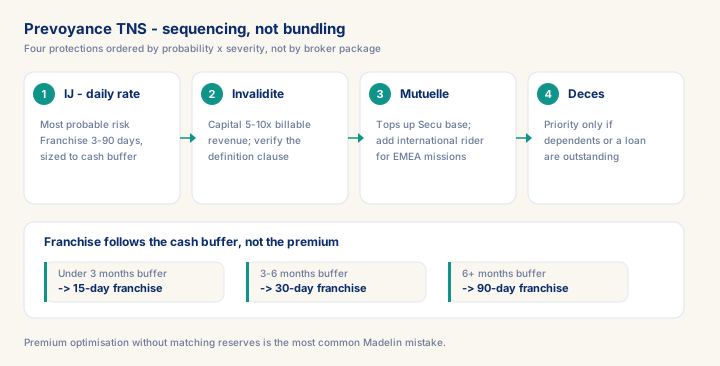
As of 2026-10-03
A consultant billing €800–1,200 a day who falls ill collapses to roughly €22–26 a day in statutory sick pay from day four — a 97% income drop the TNS regime was never built to prevent. This module sequences the four Madelin protections (indemnités journalières, invalidité, mutuelle, décès) against your actual cash buffer instead of the premium quote, and shows how to size disability capital at 5–10× billable revenue. The one clause that decides whether any of this pays out: the définition de la profession in the disability contract — read it before you sign, not after a claim is denied.
What you will learn
- Select daily indemnity delay (3, 15, 30, 60, or 90 days) based on your actual cash buffer
- Set permanent disability capital at 5–10× annual billable revenue and verify definition of disability in the policy
- Structure life insurance capital to cover dependents and outstanding loans
- Optimise Madelin deductibility within statutory ceiling and document the fiscal trail
Why TNS Coverage Is Not Like Salaried Coverage
When an employee in France stops working due to illness, the Sécurité Sociale pays daily indemnities (IJ) within three days, and the employer typically tops up to near full salary for months. When a travailleur non salarié — the regime covering most independent consultants operating under EURL or SASU who elect TNS status — stops working, the base statutory IJ from the SSI (formerly RSI) is low and capped — roughly €22–26 per day at the low end and no more than about €65 per day (PASS ÷ 730) at the top — after a waiting period of three days and subject to conditions. For a consultant billing €800–€1,200 per day, that is an income collapse of roughly 92–97% on day four. The regime does not care how much you were billing; it pays a flat, low amount calibrated for the median self-employed farmer or shopkeeper, not for a senior SAP analytics architect.
The gap between salaried and TNS protection is structural and intentional: TNS contributions go into a different pool with different actuarial rules. Understanding this is the prerequisite for every protection decision you will make.
Prerequisites
- Review core concepts first: C073, C078, C075
Outcomes
- Select daily indemnity delay (3, 15, 30, 60, or 90 days) based on cash buffer.
- Set permanent disability capital at 5-10× annual revenue.
- Apply the module's core decision: Franchise (waiting period) for IJ — choose Match the franchise to the buffer: under 3 months — 15-day franchise, 3–6 months — 30 days, 6+ months — 90 days.
- Track mastery with the KPI: Franchise-to-buffer match (target: Franchise days ≤ (months of verified cash buffer × 30); red flag: 90-day franchise selected with under 3 months of reserves actually banked).
Full module available to members. The full module adds: the decision framework · the end-to-end scenario walkthrough · the KPI scorecard · the anti-patterns · the knowledge check · the diagrams.