
Retirement for the Self-Employed
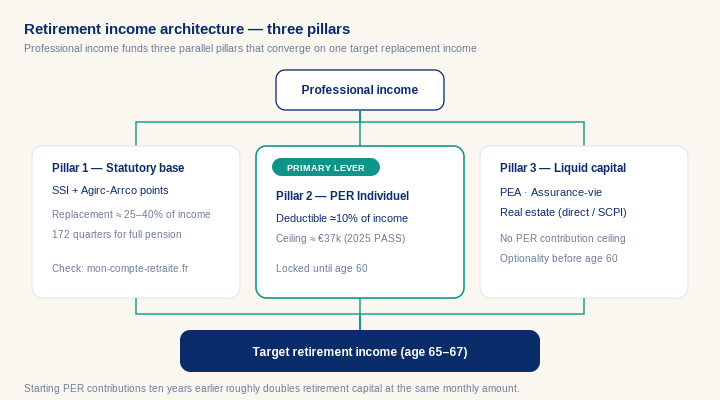
As of 2026-11-08
A senior SAP consultant billing €150,000 a year for 25 years with no additional savings retires on a statutory pension that replaces only a small share of that income (the body explains why no single rate can be quoted) — the base and complementary schemes of a TNS (SSI or Cipav; Agirc-Arrco only if paid as SASU president) were never designed to replace a high consulting income the way a salaried pension does. The single highest-leverage decision is starting PER Individuel contributions a decade earlier: €1,500/month from age 32 compounds to roughly €1.51M by 65 at an assumed 5% return, versus about €774,000 starting at 42 — the same monthly effort, half the capital. The PER Individuel deduction (≈10% of professional income, capped near €37,000 at the 2025 PASS) turns income-tax liability into retirement capital, but that capital stays locked until you claim your pension or reach the legal retirement age (62 to 64 depending on your generation), apart from the listed early-release cases. This module gives the SSI projection method, the PER contribution math, and the third-pillar liquidity plan (PEA, assurance-vie, real estate) needed to close the gap before it becomes irreversible.
What you will learn
- Calculate your realistic SSI/Agirc-Arrco projected pension and identify the annual shortfall
- Max out PER Individuel contributions within the tax deductibility ceiling each fiscal year
- Build a third pillar of invested capital (real estate, PEA, life insurance) with a documented rebalancing rule
- Model total retirement income at age 65–67, identify the under-provisioning gap, and adjust contributions annually
The Structural Under-Provisioning Problem for TNS
The pension system in France distinguishes between régimes de base and régimes complémentaires, and which ones apply to you depends on your legal form. The president of a SASU or SAS who is paid is an assimilé salarié (general scheme, with the private-sector Agirc-Arrco supplementary scheme), while the partner-manager of an EURL and the majority manager of a SARL are travailleurs non salariés (TNS) with their own base and complementary pensions (Service-Public Entreprendre, verified 8 October 2026; Service-Public — Agirc-Arrco). Independents affiliated with the SSI or, for many liberal professions, the Cipav build rights in a scheme of their own. They do not earn Agirc-Arrco points through their independent activity, and the point values and replacement ratios differ from those of salaried executives.
Prerequisites
- Working as, or planning to become, a self-employed consultant in France
- Review core concepts first: C073, C075, C045
Outcomes
- Calculate your realistic SSI/Agirc-Arrco projected pension.
- Max out PER Individuel contributions within your personalised ceiling (for a salaried SASU president, up to €37,680 for 2025 income; a TNS deducting from professional income can reach a higher ceiling).
- Apply the module's core decision: PER Individuel vs. a legacy Madelin retraite contract — choose: Direct all new contributions to a PER Individuel — it allows capital-or-rente exit, versus Madelin's mandatory rente; avoid: Transferring an existing Madelin contract without checking exit fees and grandfathered guarantees with a CGP first.
- Track mastery with the KPI: Projected replacement rate (target: ≥ 60% of pre-retirement income (SSI + Agirc-Arrco + PER + third pillar combined); red flag: < 40% two years running with no contribution increase planned).
Full module with the Consultant plan — €19.90/month. The full module adds: the decision framework · the end-to-end scenario walkthrough · the KPI scorecard · the anti-patterns · the knowledge check · the diagrams.