Your Personal Prompt Library
As of 2026-10-04
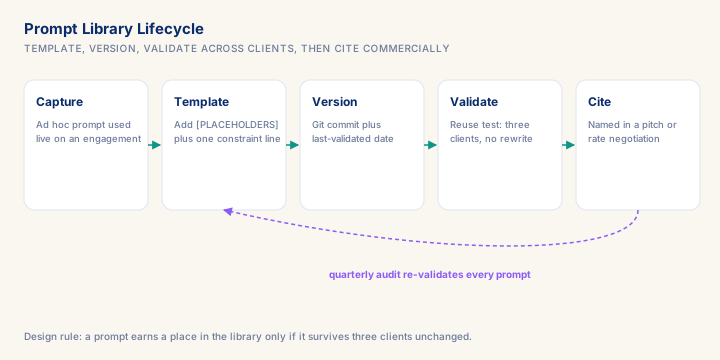
A prompt library is intellectual property, not a scratch folder: templated correctly, it survives three different clients unchanged and turns a four-hour requirements workshop into one. Consultants who version it in Git — with a "last validated" date and model name per prompt — know within minutes whether a broken output is their prompt or a model update; consultants who don't spend an hour guessing. Cite it explicitly in a capability pitch or a day-rate negotiation with procurement: "a structured prompt library that compresses administrative overhead by roughly 20-30% per engagement" is a concrete, verifiable claim, not a soft skill.
What you will learn
- Build a versioned prompt library structured for reuse across SAP analytics engagement types — from discovery workshops to BOBJ migration scoping
- Distinguish which prompts to template, which to keep ephemeral, and why the wrong choice wastes more time than no library at all
- Apply a practical maintenance discipline so your library stays useful as foundation models change and client contexts shift
- Use your prompt library as a visible differentiator in capability presentations and day-rate negotiations with procurement teams
A prompt library is not a folder of saved ChatGPT conversations. It is a structured, versioned asset — the same professional discipline you apply to a macro-enabled Excel model or a reusable BTP integration template. (SAP BTP has since been renamed SAP Business AI Platform, announced at SAP Sapphire 2026.) Consultants who treat it as a random collection of 'things that worked once' end up rebuilding from scratch on every engagement. Consultants who maintain it like an intellectual property asset compound their efficiency across years.
What belongs in a prompt library — and what does not
The test for inclusion is reusability across at least three different clients without material rewrite. If you had to rephrase the prompt completely for a different client or project type, it was context-specific, not generic. Context-specific prompts are ephemeral — use them once, discard them.
Candidates that genuinely belong in an SAP analytics consultant's library:
Prerequisites
- Intermediate hands-on experience on SAP analytics projects
- Review core concepts first: C088, C092, C087
Outcomes
- Work through a realistic scenario: A four-consultant boutique supporting a German Tier-1 automotive supplier's SAP Datasphere rollout decides to turn its ad hoc prompt use into a shared.
- Recognize and avoid the anti-pattern: Saving every prompt that worked once — A 400-entry library where finding anything under deadline pressure takes longer than rewriting from scratch.
- Apply the module's core decision: Include a prompt in the library, or discard it — choose Template it with [BRACKETED] placeholders and one explicit failure-mode constraint before committing.
- Track mastery with the KPI: Reuse rate (target: >= 3 clients per templated prompt, unchanged; red flag: A prompt used once and never revisited — it should not have been committed).
Full module available to members. The full module adds: the decision framework · the end-to-end scenario walkthrough · the KPI scorecard · the anti-patterns · the code blocks · the knowledge check · the diagrams.