Meetings: 5 Formats That Pay, 10 That Don't
As of 2026-10-04
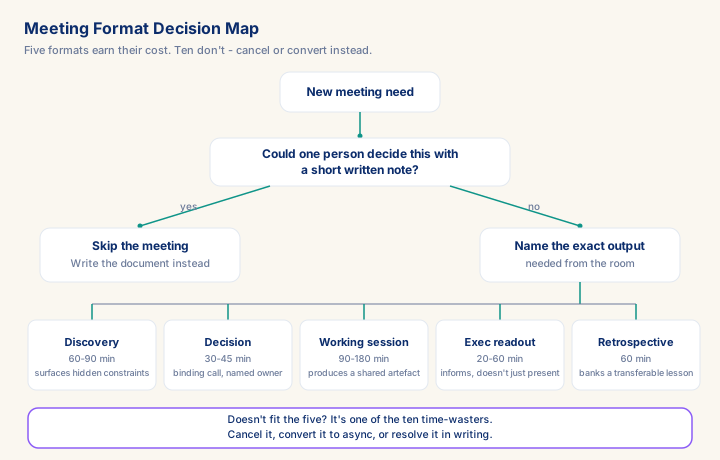
A 60-minute meeting with six people pulled from deep-work time costs roughly €1,400 in billable time at a €900/day rate—before prep, follow-up, or the cost of fracturing the day around it. Most of that spend is avoidable: status updates that belong in a document, alignment checks a single written sentence would resolve, brainstorms that group dynamics make worse than solo thinking first. This module gives five formats that earn their cost—discovery, decision, working session, executive readout, retrospective—each with a concrete execution discipline, and ten that don't, each with the fix. The rate-conversation payoff: a consultant who can cite one converted meeting and its measured impact (nine hours a week freed, a go-live pulled forward two weeks) is arguing from delivery leverage, not soft skills.
What you will learn
- Identify the five meeting formats that produce irreplaceable value on SAP analytics engagements and apply the execution discipline for each
- Recognise and eliminate the ten recurring time-waste meeting formats using concrete diagnostic tests
- Facilitate a structured meeting that opens with a purpose statement, includes a mid-meeting time check, and closes with a verbatim decision record
- Decline meetings professionally and propose the right alternative path when a meeting would not produce a specific, irreplaceable output
Why most meetings on SAP projects are value-negative
A meeting costs more than its duration. A 60-minute meeting with six participants drawn from their deep-work blocks costs six hours of work—plus the ramp-up and ramp-down cognitive overhead on either side (typically 15–20 minutes per person per session). On a day-rate engagement at €900/day, that single meeting costs the client roughly €1,400 in billable consultant time—before any preparation or follow-up is counted. If the meeting produces a decision that could have been made by one person with an email, or an update that could have been written in a status document, the meeting is a net loss.
The asymmetry is worse than it appears because meetings do not just cost the time spent in them. They fracture the day. A 10:00–11:00 meeting followed by a 14:00–15:00 meeting creates two 2–3 hour windows that feel like they should accommodate deep work but in practice do not—the awareness of the upcoming meeting creates what G. M. at UC Irvine calls 'anticipatory fragmentation,' a subtle background cognitive load that prevents the depth needed for real modelling or analysis work.
Prerequisites
- Intermediate hands-on experience on SAP analytics projects
- Review core concepts first: C087, C091, C090
Outcomes
- Work through a realistic scenario: A consultant joins a mid-size manufacturer's SAP BW/4HANA-to-Datasphere migration where the steering committee and workstream leads are booked into roughly 14 hours.
- Recognize and avoid the anti-pattern: Booking a meeting 'to be safe' instead of naming the decision it will produce — The calendar fills with cover-seeking meetings that produce information nobody acts.
- Apply the module's core decision: Call a meeting, or write it down.
- Track mastery with the KPI: Meeting spend per week (target: < 15% of billable hours across the team; red flag: > 25% signals a calendar that is quietly taxing delivery).
Full module available to members. The full module adds: the decision framework · the end-to-end scenario walkthrough · the KPI scorecard · the anti-patterns · the knowledge check · the diagrams.