Time Tracking Without Misery: The 15-Min Rule
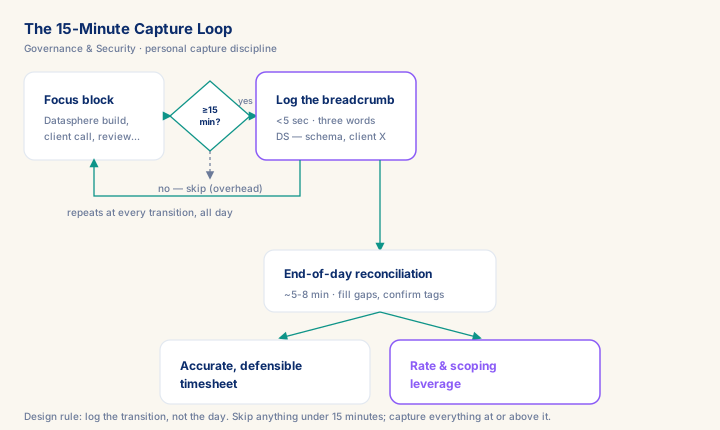
As of 2026-10-05
Consultants who bill by the day lose real money to memory, not laziness: end-of-week reconstruction runs at roughly 40-50% recall accuracy for anything more than a day old, and a senior architect billing €950/day who loses just 45 minutes a day to under-logging is giving up close to €19,000 a year. The fix is not a better timesheet app — it is a habit change: log a three-word breadcrumb at every activity transition, using 15 minutes as the cut-off between overhead and billable work. Run that discipline for a full engagement and the payoff compounds beyond the invoice: a documented delivery history is the strongest asset in a rate negotiation and the only honest basis for quoting a fixed-price scope.
What you will learn
- Apply the 15-minute transition-moment logging rule consistently across multi-client SAP delivery work
- Select and configure a time-tracking tool that meets the five-second accessibility threshold for transition-moment capture
- Quantify the revenue and positioning value of granular historical time data for rate negotiations
- Structure a multi-client project taxonomy that eliminates end-of-week reconstruction guesswork
Module overview
Why most time tracking fails within two weeks
Every SAP analytics consultant who bills by the day or manages multiple workstreams has been there: Sunday evening, staring at a blank timesheet for the week, trying to reconstruct six days of Datasphere modelling, client calls, proposal writing, and two unexpected production incidents from memory. The result is rounded numbers, guessed allocations, and a vague guilt that you've probably under-reported on the client who pays the most and over-reported on the one you can't quite remember.
This isn't a discipline problem. It is a system problem. Humans cannot reliably recall hour-level activity across five days — cognitive science puts our reconstruction accuracy at around 40–50% for tasks completed more than 24 hours ago. Every day you wait to log is a day of signal permanently lost. The 15-minute rule is the only pattern that reliably survives real delivery pressure.
Prerequisites
- Intermediate hands-on experience on SAP analytics projects
- Review core concepts first: C087, C091, C090
Outcomes
- Work through a realistic scenario: A senior Datasphere architect billing three EMEA clients concurrently suspects she is losing billable time but cannot prove how much.
- Recognize and avoid the anti-pattern: Logging in arrears with no breadcrumb system — End-of-day reconstruction fails for the same reason end-of-week reconstruction did — the habit moved.
- Apply the module's core decision: Which tracking tool to standardise on — choose Toggl Track for independents who need sub-five-second capture and a direct line into invoicing.
- Track mastery with the KPI: Billable capture rate (target: >= 95% of a contracted working day logged against a named project; red flag: < 85% signals systematic under-billing — at a €950/day rate).
Full module available to members. The full module adds: the decision framework · the end-to-end scenario walkthrough · the KPI scorecard · the anti-patterns · the knowledge check · the diagrams.