Energy Management vs Time Management
As of 2026-10-04
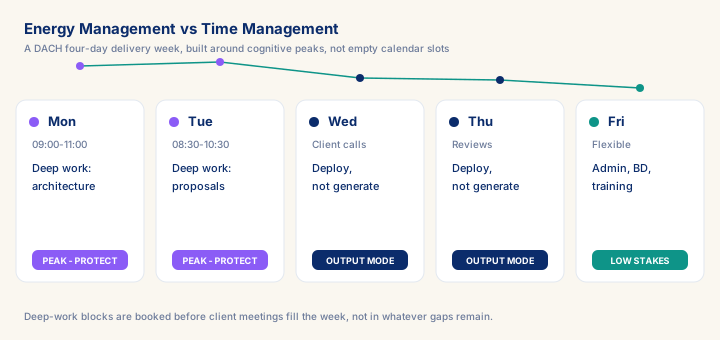
Energy management is a calendar-architecture decision, not a wellness habit: senior SAP analytics work follows a 90-120 minute ultradian cycle, and the same architecture review done at a cognitive peak versus a trough produces measurably different quality. The decision this module drives is where deep-work blocks for Datasphere design, BW/4HANA modelling, or SAC review sit in the week — before client meetings fill the calendar, not in whatever gaps survive. The stake is direct: a consultant who protects two 90-minute peak blocks a week ships architecture decisions that hold up under CTO review and closes scope within 15%, which is the differentiation behind a €1,100+/day rate. Get the calendar architecture wrong and the same technical knowledge produces late-afternoon work that looks finished but hides errors a rested peer would catch in the morning.
What you will learn
- Map your personal ultradian peak pattern and restructure your calendar to align complex SAP architecture work with cognitive high-performance windows
- Design a weekly deep-work block structure that shields 90-minute focus sessions from reactive meeting pressure
- Apply evidence-based recovery practices at trough periods that genuinely restore attentional capacity rather than consuming it
- Identify the three sleep and exercise leverage points most likely to raise your cognitive performance ceiling on high-stakes client engagements
Module overview
The calendar lie most consultants tell themselves
A typical senior SAP analytics consultant's Monday looks like this: 09:00 Datasphere architecture review, 10:30 SAC planning model call, 12:00 lunch, 13:00 proposal for a new BDC opportunity, 15:00 technical review of a BW/4HANA migration, 16:30 team briefing, 17:30 inbox. On paper, that is a productive day. In practice, by 15:00 the thinking is blurred. The BW migration review produces half the insight it would have produced at 09:30. The architecture call at 10:30 generated the best ideas of the day. This is not a motivation problem. It is a biology problem.
Time management — scheduling tasks into calendar blocks — treats all hours as equivalent units. They are not. The human brain cycles through roughly 90-120 minute periods of higher and lower alertness throughout the waking day, a pattern called the ultradian rhythm. Cognitive performance on complex analytical work tracks these cycles closely. Managing your energy means understanding this cycle and aligning your highest-demand SAP work with your peaks — not your lowest-friction meetings.
Prerequisites
- Review core concepts first: C087, C086, C075
Outcomes
- Work through a realistic scenario: A senior consultant is delivering a 10-week BW/4HANA-to-Datasphere migration for a DACH automotive-parts manufacturer.
- Recognize and avoid the anti-pattern: Scheduling the most important analytical work in the late-afternoon meeting gaps — Datasphere, BW/4HANA.
- Apply the module's core decision: Where to place deep-work blocks in the week — choose Book 2-3 fixed 90-minute peak-hour blocks (typically 08:30-11:00) before any client meeting is scheduled.
- Track mastery with the KPI: Deep-work blocks protected per week.
Full module available to members. The full module adds: the decision framework · the end-to-end scenario walkthrough · the KPI scorecard · the anti-patterns · the knowledge check · the diagrams.