AI Agents: Real Use Cases vs Hype
As of 2026-10-10
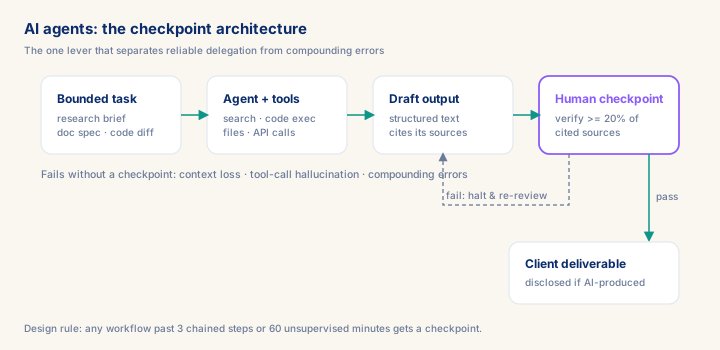
AI agents are reliable today for four bounded tasks — research briefings, documentation drafted from structured specs, code pattern review, and transcript-to-structured-output — and unreliable for everything sold as "autonomous." The dividing line is not capability, it is checkpoint design: an agent that hands a human a reviewable output before it touches a deliverable works; an agent left unsupervised on a multi-hour task compounds errors quietly and expensively. A senior SAP analytics consultant who names the three failure modes — context loss, tool-call hallucination, compounding errors — and builds review gates around them earns the day-rate premium that uncritical adopters and uncritical rejecters both miss. Client data confidentiality (DPA coverage, no client SAP exports through consumer AI apps) is the one non-negotiable in this conversation.
What you will learn
- Distinguish what AI agents genuinely deliver today in bounded, well-defined tasks versus where full-autonomy claims collapse under real-world conditions — with specific examples from SAP analytics work
- Identify four concrete, currently-working agent use cases for an SAP analytics consultant and understand the constraints that make them reliable
- Recognise the three most common failure modes of agentic AI systems — context loss, tool-call hallucination, and compounding errors — and know how to catch them before they cause delivery problems
- Position honest AI agent fluency as a senior differentiator — knowing what to delegate and what to keep human-reviewed — in capability conversations and day-rate negotiations
The AI agent landscape in 2025-2026 is a genuine split between two realities: a narrow set of tasks where agents are reliable, measurably useful, and already deployed by practitioners; and a much wider set of tasks where the marketing language — autonomous, self-improving, fully automated — describes a capability that does not yet exist in production with acceptable reliability. For an SAP analytics consultant, the question is not whether agents are useful (they are) but which specific applications are worth adopting now versus which will cause more problems than they solve.
What 'agent' actually means in 2025
An AI agent is a language model equipped with tools — the ability to take actions, not just produce text. The tools might be: web search, code execution, file reading, API calls, or controlling a browser. The language model decides which tools to call, in which order, based on an overarching goal you gave it. The key difference from a standard chat interaction is that the agent operates across multiple steps without you intervening between each one.
Prerequisites
- Intermediate hands-on experience on SAP analytics projects
- Review core concepts first: C087, C091, C090
Outcomes
- Work through a realistic scenario: A Big-4 team is six weeks into a four-month SAP Datasphere migration for a German industrial manufacturer and wants to use AI agents to speed up research and documentation.
- Recognize and avoid the anti-pattern: Treating agent output as final because it is coherent — A fabricated partnership announcement or citation ships in a client brief.
- Apply the module's core decision: Which tasks to delegate to an agent this month — choose Delegate research briefings, spec-to-doc generation, code pattern checks, and transcript-to-structured-output.
- Track mastery with the KPI: Citation verification rate (target: >= 20% of cited URLs checked before accepting a research brief; red flag: Any fabricated or dead citation found).
Full module available to members. The full module adds: the decision framework · the end-to-end scenario walkthrough · the KPI scorecard · the anti-patterns · the code blocks · the knowledge check · the diagrams.