Deep Work: Protecting Your 4 Hours
As of 2026-10-03
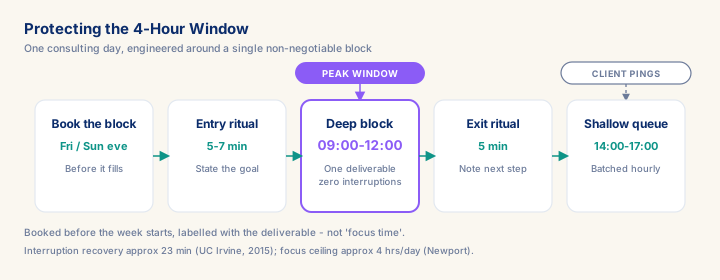
C. N.'s four-hour ceiling on deep cognitive work is not a productivity tip — it is the constraint that decides whether a Datasphere model, a BDC architecture, or a business case survives client review. Consultants who book, ritualise, and defend that window bill fewer scattered hours but ship work with less rework; EMEA data ties the discipline to a 15-25% day-rate premium above peer median. This module gives you the booking ritual, the entry and exit rituals, and the client-facing language to protect the block without reading as unavailable. The one number that matters: a single broken deep-work session costs roughly 23 minutes of recovery time — enough to turn a three-hour design task into a five-hour one.
What you will learn
- Identify your personal peak cognitive window on a client engagement and defend it against calendar colonisation
- Apply the booking ritual, entry ritual, and shutdown ritual to a real SAP analytics project week
- Communicate focus-block boundaries to client stakeholders without damaging the relationship
- Position structured deep-work discipline as a premium-rate differentiator in client and firm conversations
Why four hours is the real number
C. N.'s Deep Work, building on Anders Ericsson's research on deliberate practice, converges on the same ceiling: most professionals produce genuinely original, high-value intellectual work for no more than four hours a day. After that, what feels like thinking is usually pattern-matching at low intensity. For an SAP analytics consultant, those four hours are the window in which you design a non-trivial data model, build a Datasphere analytic model that actually performs, challenge a client's reporting logic, or write a business case that withstands a CFO's scrutiny. The rest of the day—calls, Jira, email, stand-ups, relationship management—is real work too, but it does not require the same cognitive depth. The error most consultants make is spending their sharpest morning hours on the shallow queue, then arriving at the data model or the architecture decision exhausted.
Prerequisites
- Review core concepts first: C085, C087, C092
Outcomes
- Work through a realistic scenario: A 12-week Datasphere migration for a German industrial-equipment manufacturer.
- Recognize and avoid the anti-pattern: Treating sprint ceremonies as non-negotiable — Daily stand-ups and status calls colonise the morning peak by default, and the schedule is never revisited once it's set.
- Apply the module's core decision: Which hours to protect — choose The block that produced your best-reviewed work in the trial week; for most EMEA consultants this is 09:00-12:00.
- Track mastery with the KPI: Protected-block adherence (target: >= 4 of 5 weekdays with the peak block held uninterrupted; red flag: < 3/5 days means the block is decorative, not operational).
Full module available to members. The full module adds: the decision framework · the end-to-end scenario walkthrough · the KPI scorecard · the anti-patterns · the knowledge check · the diagrams.