
Building Your Personal Operating System
As of 2026-11-08
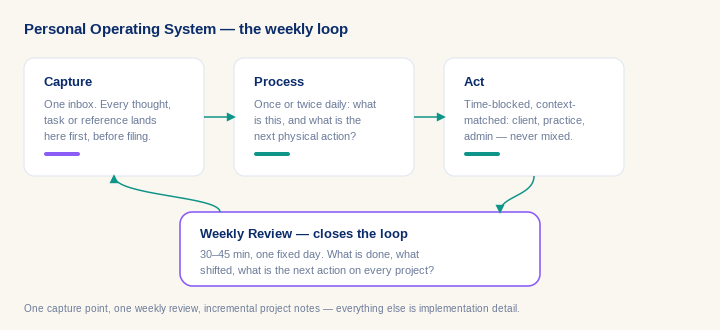
Most SAP consultants run through several overlapping tools and abandon each new productivity method by month 3, not because Notion or GTD is wrong, but because a system built for someone else's life rarely survives an engagement that changes context every few weeks. This module gives six operating principles instead of another app: one capture point, capture separated from processing and action, a living projects list anchored by a 30 to 45 minute weekly review, project knowledge externalised as it happens, the calendar as ground truth, and friction-free reference. For consultants who cross borders it adds the verified rules that shape the system: the EU 11-hour daily rest benchmark, recording law in Germany and Switzerland, and GDPR processor duties for AI note-takers. A consultant who shows up prepared and hands over clean documentation reads as lower risk, which supports the next day-rate increase.
What you will learn
- Diagnose the four failure modes in a consultant information management: capture failure, context collapse, task debt, and knowledge decay
- Design a single-inbox capture workflow with a defined processing cadence and context-separated action blocks
- Build a weekly review routine that maintains a living projects list and prevents system collapse
- Externalise project knowledge incrementally to produce reusable IP from every engagement
Why Your Productivity System Keeps Failing
Every two years a new productivity method gets attention: Getting Things Done, Building a Second Brain, Zettelkasten, PARA. Consultants adopt the tool (Notion, Obsidian, Things 3), spend a weekend migrating notes, and drop it by month 3 (typical pattern, not a measured rate). The tool is rarely the cause. The cause is buying a system designed for someone else's life and expecting it to survive an SAP analytics engagement that changes context every few weeks.
A personal operating system is the set of rules that governs how you capture, process and act on information. It is not a tool stack. This module gives 6 principles, a 40 minute weekly review, and the country-specific rules that decide what you may record, store and answer when you work across borders (Germany, Switzerland, France, the United Kingdom and the wider EU).
Prerequisites
- Intermediate hands-on experience on SAP analytics projects
- Review core concepts first: C092, C087, C086
Outcomes
- Work through a realistic scenario: A consultant opens a six-month Datasphere governance engagement with a pharmaceutical client while a productivity system that has already failed three times in two years gets one more, disciplined attempt.
- Recognize and avoid the anti-pattern: Over-engineering before using — Weeks spent building a perfect taxonomy before there is any real content to file in it -- momentum dies before the system is ever tested.
- Apply the module's core decision: Which capture point to standardise on — choose: One tool -- voice memo, physical notebook, or a task manager inbox -- used consistently, processed on a fixed daily or twice-daily cadence; avoid: A hybrid of three capture tools that feels thorough but fragments attention and guarantees some items are never processed.
- Track mastery with the KPI: Capture-to-process latency (target: Every inbox item processed within 24 hours; red flag: Anything older than one week -- the capture point has become a junk drawer, not a system).
Full module with the Consultant plan — €19.90/month. The full module adds: the decision framework · the end-to-end scenario walkthrough · the KPI scorecard · the anti-patterns · the knowledge check · the diagrams.