
Annual Review & Quarterly Planning
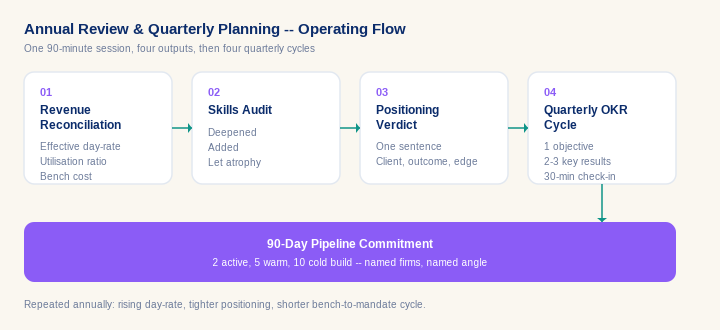
As of 2026-11-07
A freelance SAP analytics consultant who skips the annual review enters the year not knowing their real utilisation, their actual skills trajectory, or a positioning sentence a client could repeat. This module builds a 90-minute annual review that turns a year of invoices into four numbers -- effective day-rate, utilisation ratio, bench cost, and a one-sentence positioning verdict -- then converts them into a quarterly OKR cycle with a named 90-day pipeline. The stakes are concrete: a consultant billing 1.2 R a day (R is the platform P50 for the profile) who lets utilisation drift below 0.70 is losing tens of thousands of euros to unfilled bench days, and one who cannot state their positioning in one sentence is competing on rate against 200 generalists instead of being the obvious hire. Done annually, in writing, this review is what lets a senior consultant open a rate conversation with evidence instead of an opinion.
What you will learn
- Build a complete annual revenue reconciliation including effective day-rate, utilisation ratio, and bench cost
- Conduct a three-column skills audit distinguishing deepened, added, and atrophied capabilities
- Write a one-sentence positioning statement specific enough to generate referrals
- Design a quarterly OKR-light planning cycle with outcome-based Key Results and a 90-day pipeline commitment
An annual review is a 90 min working session that produces four outputs in writing: a revenue reconciliation, a skills and credential audit, a one-sentence positioning verdict, and a 90-day pipeline commitment. Four 30 min quarterly reviews keep them honest. This module gives the arithmetic, the templates, and the dated SAP sources to check before you write a claim into next year's plan.
Why winging the year fails
Most SAP analytics consultants end December with a sense that they worked hard, then struggle to say what they billed, which skills they used, and whether they moved forward. Without numbers, next year's rate conversation is a feeling against a client's procurement data. Without a skills audit, the CV keeps listing what you did three years ago. Without a pipeline commitment, January starts with hope instead of names. The review fixes all three in one sitting; block 90 min in the last two weeks of December and treat it as a client meeting.
Prerequisites
- Intermediate hands-on experience on SAP analytics projects
- Review core concepts first: C087, C017, C092
Outcomes
- Work through a realistic scenario: An independent Datasphere consultant runs their annual review and Q1 planning in the gap between the December engagement close and the first client kickoff of the new year.
- Recognize and avoid the anti-pattern: Reviewing without deciding — The annual review becomes a diary entry: observations with no rate change, no dropped skill, and no committed pipeline number.
- Apply the module's core decision: How to calculate bench cost — choose: Bench days x your target day-rate, so the number is uncomfortable enough to change behaviour -- e.g. 40 bench days at 1.2 R/day is 48 R of lost margin; avoid: Reporting only total revenue billed: it hides the cost of unbilled time and lets a falling utilisation ratio go unnoticed for years.
- Track mastery with the KPI: Utilisation ratio (target: 0.75-0.88 for a freelance consultant at steady state; red flag: Below 0.70 (pipeline failure or over-specialisation) or above 0.90 (no investment in skills, network, or positioning)).
Full module with the Consultant plan — €19.90/month. The full module adds: the decision framework · the end-to-end scenario walkthrough · the KPI scorecard · the anti-patterns · the knowledge check · the diagrams.