Book Writing: The 18-Month Asset
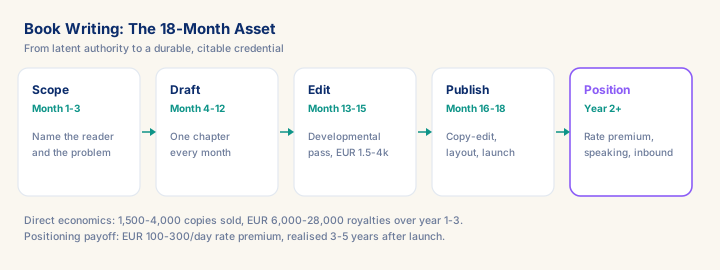
As of 2026-10-04
A practitioner book converts a decade of project judgment into a durable, citable credential — the asset your best clients quote when explaining why they hired you. The realistic economics: 18 months of effort at roughly three hours per week, direct royalty income of €6,000-28,000 on 1,500-4,000 copies sold, and a rate premium of €100-300 per day that materialises three to five years after publication — worth €15,000-45,000 per year on a typical 150 billing-day calendar. The decision that makes or breaks the project is scoping: a book needs a named reader and a specific problem, not a topic. Most manuscripts die at the 50% draft mark from lack of external accountability, not from lack of material.
What you will learn
- Evaluate the realistic direct and indirect ROI of writing a practitioner book versus the 18-month time cost
- Scope a book correctly: define reader, problem, and specific claim to avoid the too-broad failure mode
- Design an 18-month writing timeline that fits around active consulting delivery at three hours per week
- Compare self-publishing and traditional publishing trade-offs for SAP analytics specialist titles
What a book actually does for a consultant's positioning
A book is not a marketing tactic. It is a credential that reorganises how the market perceives your expertise. Before you write one, it is worth being precise about what it does and does not do.
What it does: it converts latent authority — the judgment you have accumulated across dozens of projects — into a durable, referenceable artefact that others can find, cite, and share without you present. A well-scoped book on SAP Datasphere architecture patterns, for example, becomes the thing that your best clients mention when explaining to colleagues why they hired you, the thing that programme directors put on recommended reading lists, and the thing that comes up in Google searches when someone is trying to figure out who the real practitioners are in a topic. None of that happens fast. Most of it happens two to four years after publication. The 18-month effort creates an asset whose commercial payoff horizon is five to ten years.
Prerequisites
- Intermediate hands-on experience on SAP analytics projects
- Review core concepts first: C077, C008, C087
Outcomes
- Work through a realistic scenario: A senior SAP Datasphere architect at a 15-person boutique consultancy commits to an 18-month book on hybrid BW/4HANA-to-Datasphere migration patterns.
- Recognize and avoid the anti-pattern: Waiting for a quiet month to start writing — The quiet month never arrives and the book never gets a first sentence.
- Apply the module's core decision: How broadly to scope the book — choose Narrow to one reader and one problem tight enough that 60,000 words are all genuinely useful — e.g.
- Track mastery with the KPI: Weekly writing cadence (target: >= 3 hours/week sustained; red flag: < 1 hour/week for three consecutive weeks — the earliest abandonment signal).
Full module available to members. The full module adds: the decision framework · the end-to-end scenario walkthrough · the KPI scorecard · the anti-patterns · the knowledge check · the diagrams.