GTD for Consultants: Inbox Zero Without the Cult
As of 2026-10-04
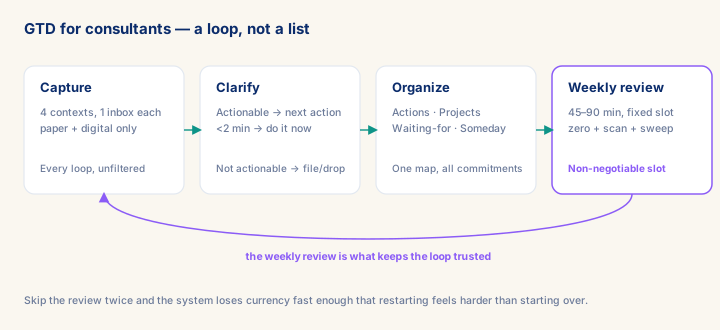
Getting Things Done is not about tidiness — it is the operating discipline that decides whether a consultant drops commitments under multi-workstream load. The method needs almost no tooling: two capture points, a next-action rewrite of every vague task, and a 45-to-90-minute weekly review that most consultants abandon within two weeks of starting it. Clients never see the system, but they feel its absence immediately — in missed follow-ups, in status updates that require chasing, in dependencies nobody tracked. The consultants who never drop a commitment and surface the client's own open items before being asked are the ones renewed without a competitive tender; that reputation is what the day-rate premium is actually paying for.
What you will learn
- Build a minimal two-point capture system that catches all open loops across meeting, email, work, and background contexts
- Apply the clarify step to transform vague captured items into specific next physical actions and a maintained project list
- Run a weekly review in 60 minutes using the seven-step format that keeps a consultant's full landscape current
- Integrate GTD with client project tools without trying to consolidate them into a single system
The problem GTD solves for consultants — and the one it does not
A typical SAP analytics consultant runs four to six simultaneous workstreams: active project delivery, two or three proposal or pre-sales conversations, an ongoing stream of client questions about previous work, administrative overhead (timesheets, expenses, invoicing, compliance training), and whatever professional development they are meant to be pursuing. Most people manage this through a combination of their email inbox, a calendar, a project tool enforced by their client, and a personal to-do list maintained in their head. The cognitive load is enormous. Things fall through gaps not because of incompetence but because there is no system that has the whole picture.
D. A.'s Getting Things Done methodology, first published in 2001 and revised in 2015, is the most battle-tested personal productivity system for knowledge workers dealing with this exact fragmentation. Its core insight is deceptively simple: your brain is for generating ideas and making judgments, not for storing open loops. Every commitment, task, question, and intention that lives in your head is a background process consuming working memory. Externalising everything into a trusted system frees that working memory for the work that actually needs you.
Prerequisites
- Review core concepts first: C087, C092, C091
Outcomes
- Work through a realistic scenario: A consultant joins week one of a six-month BW/4HANA-to-Datasphere migration for a Tier-1 automotive supplier.
- Recognize and avoid the anti-pattern: Building the system as a weekend project — An elaborate setup in a new tool feels impressive on Sunday and unmaintainable by Tuesday morning.
- Apply the module's core decision: Which capture tool stack to standardise on — choose A two-point stack — one physical notebook for meeting capture, one digital next-actions list — kept deliberately boring.
- Track mastery with the KPI: Weekly review completion (target: Completed on the same day/time every week, 90%+ of weeks; red flag: Two consecutive weeks skipped).
Full module available to members. The full module adds: the decision framework · the end-to-end scenario walkthrough · the KPI scorecard · the anti-patterns · the knowledge check · the diagrams.