Building Your Second Brain (PARA Method)
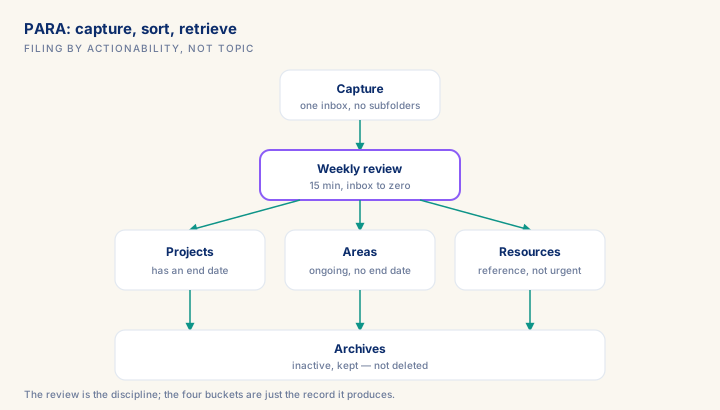
As of 2026-10-03
PARA turns a knowledge worker's most common hidden cost — the twenty minutes lost every time a consultant re-derives something they already learned — into a four-bucket filing habit: Projects, Areas, Resources, Archives, sorted by whether something is actionable, not by its topic. The system pays for itself quickly: on a day rate around €1,200, recovering just two hours a week of re-research is roughly €7,500 a year of billable capacity. The single decision that makes or breaks it is not the folder structure — it is whether a frictionless capture inbox and a 15-minute weekly review actually happen, because without that habit the system collapses into an unsorted backlog within a couple of months.
What you will learn
- Map a working consultant's knowledge to the four PARA categories — Projects, Areas, Resources, Archives — and understand why the boundaries matter for retrieval speed
- Design a capture-to-retrieval workflow that survives the context-switching reality of multi-client consulting work
- Build a reusable asset library from client engagement notes without violating confidentiality obligations
- Explain the PARA discipline and its business value in a client or recruiter conversation
The problem PARA solves
Most consultants have a knowledge problem that looks like a volume problem. They have notes — thousands of them — spread across email threads, meeting recordings, shared drives, a personal tool, and a client's SharePoint. When a partner asks for a precedent, or when they are preparing a proposal and need to remember what they learned about BPC on the Zurich engagement two years ago, retrieval fails. Not because the knowledge was never captured, but because it was captured without a system that supports retrieval.
T. F.'s PARA method — Projects, Areas, Resources, Archives — is the most practically useful note-organisation framework a knowledge worker can adopt. It is not a productivity philosophy or a mindfulness practice. It is a filing system with one design constraint: every note lives in exactly one of four buckets, chosen based on actionability, not topic. Understanding why actionability beats topicality is the whole point.
Prerequisites
- Review core concepts first: C086, C087, C092
Outcomes
- Work through a realistic scenario: A consultant joins a six-month SAP BDC migration for a DACH retail bank, working alongside two colleagues who will rotate on and off the engagement.
- Recognize and avoid the anti-pattern: Filing by topic instead of actionability — Recreates the topical mess PARA was meant to fix.
- Apply the module's core decision: Projects vs Areas classification — choose File it as a Project only if you can name the day it closes and what ‘done’ looks like; ongoing responsibilities — rate tracking.
- Track mastery with the KPI: Capture-to-file lag (target: Inbox cleared to zero at every weekly review; red flag: More than about 10 unfiled items carried into a second week).
Full module available to members. The full module adds: the decision framework · the end-to-end scenario walkthrough · the KPI scorecard · the anti-patterns · the knowledge check · the diagrams.