Prompt Engineering for Consultants: The 10 Patterns
As of 2026-10-10
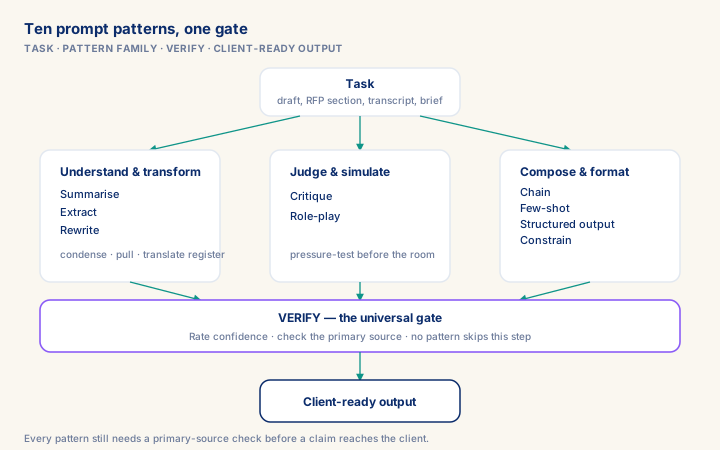
Every consultant now has a language model one tab away; the scarce skill is no longer access but judgment — knowing which of ten reusable patterns to reach for, and where each one quietly fails. This module gives you those ten patterns — Summarise, Extract, Rewrite, Critique, Role-play, Chain, Few-shot, Structured-output, Constrain, Verify — each with its documented failure mode and a verification step, so AI-assisted drafts survive a partner review instead of getting caught by one. The commercial case is concrete, not aspirational: turning a 60-page RFP into a structured gap analysis in forty minutes instead of a day is billable time recovered, not a productivity slogan. The rule that decides the rate conversation: every pattern still needs an expert to check its output, so the value compounds with the consultant's seniority — a senior charges for the judgment, not for typing the prompt.
What you will learn
- Recognise and apply the 10 core prompt patterns — Summarise, Extract, Rewrite, Critique, Role-play, Chain, Few-shot, Structured-output, Constrain, and Verify — with SAP-analytics-specific examples
- Construct prompts that are reproducible across sessions and shareable with colleagues rather than ad hoc and ephemeral
- Identify the failure modes of each pattern — where the model hallucinates, oversimplifies, or agrees too readily — and apply verification discipline before using the output
- Demonstrate measurable productivity gains from prompt engineering to a client or partner audience without overstating AI capability
What prompt engineering actually is
Prompt engineering is not a mystical skill. It is the discipline of communicating precisely with a language model — giving it enough context, a clear task, and the right constraints so that its output is useful without extensive editing. For a consultant, the relevant question is not "how do I become a prompt expert" but "which patterns save me the most time on the work I actually do every day?"
The ten patterns below are drawn from daily consulting workflows. Each one has a concrete SAP-analytics-flavoured example, an honest note on where it fails, and a verification step. The patterns are not abstract categories — they are reusable templates you can store in your notes, refine over time, and share with colleagues.
One preliminary note on tooling: Claude, ChatGPT, and Gemini all support these patterns. The examples use generic framing, but the same pattern works across models. The more important choice is not which model but whether you are working in a persistent conversation (where earlier context informs later outputs) or a fresh session (where you must reload context every time). For complex patterns like Chain, persistent conversations are significantly better.
Prerequisites
- Review core concepts first: C087, C092, C091
Outcomes
- Work through a realistic scenario: A three-person SAP Datasphere team is answering an RFP from a regulated European bank, with an eight-day deadline and a 60-page requirements document nobody has fully read.
- Recognize and avoid the anti-pattern: Trusting a HIGH confidence rating without a primary-source check — A wrong version number or regulatory detail reaches the client.
- Apply the module's core decision: Which pattern to reach for first — choose Match the pattern to the task: Extract or Structured-output for anything a script or a colleague will parse.
- Track mastery with the KPI: Verification coverage (target: 100% of client-facing factual claims checked against a primary source; red flag: Any HIGH-confidence claim involving a version number, date).
Full module available to members. The full module adds: the decision framework · the end-to-end scenario walkthrough · the KPI scorecard · the anti-patterns · the code blocks · the knowledge check · the diagrams.