Brand Risk: When Content Goes Wrong
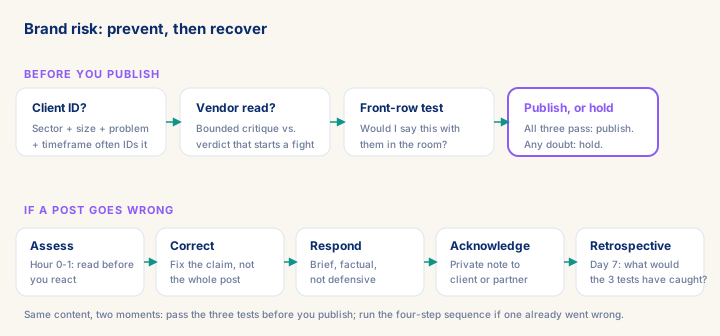
As of 2026-10-06
A single confidentiality slip or vendor-antagonising LinkedIn post can cost a consultant a referral pipeline within twenty-four hours, in a market where a few thousand EMEA SAP analytics practitioners read the same feed. The decision that matters: publish only when a post survives three tests — could an insider identify the client, could a vendor read it as a commercial attack, and would you say it with that person in the front row. This module gives the four confidentiality failure patterns specific to SAP project work and the four-step recovery sequence for when a post has already gone wrong. The stake is concrete: reputation signal is priced into day rate, and the consultant who handles a brand-risk incident with precision and no drama commands a premium over one who goes silent or defensive.
What you will learn
- Apply the three pre-publication questions to any substantive content to assess confidentiality, vendor, and community relationship risk before posting
- Identify the four confidentiality failure modes specific to SAP consulting case studies and benchmarks, and apply the six-month delay rule to recent client work
- Execute the four-step recovery sequence — assess, correct specifically, respond directly, acknowledge privately — when published content creates a brand risk
- Distinguish between the level of opinion that builds credible expertise and the level that creates commercial or relational damage, and calibrate content accordingly
The Day the Post Goes Wrong
A Datasphere architect publishes a LinkedIn post on a Sunday morning. It is a comparison of two enterprise data platform vendors — SAP Datasphere versus a major cloud alternative. By Monday afternoon, the post has been shared seventeen times, including by someone in the marketing department of the vendor she criticised. The vendor's regional VP sends her a connection request with a message: 'Happy to discuss your analysis.' Two of her current referral contacts quietly unlike the post.
She did nothing illegal, nothing factually incorrect, and nothing she would not defend at a dinner table. But by Tuesday, she is managing the situation instead of doing client work.
Brand risk in public consulting is not theoretical. It is a specific, recurring pattern with specific causes and specific recovery paths. What follows: prevention, early detection, and the recovery sequence when something goes wrong.
Why SAP Analytics Consultants Face Distinctive Brand Risks
SAP analytics consulting sits at the intersection of three tensions that make brand risk higher than in most other professional fields:
Prerequisites
- Intermediate hands-on experience on SAP analytics projects
- Review core concepts first: C078, C083, C082
Outcomes
- Work through a realistic scenario: A Datasphere architect at a mid-size SAP consultancy publishes a vendor-comparison post on a Sunday morning.
- Recognize and avoid the anti-pattern: Deleting a post after it already has visible engagement, with no explanation — Removes context for everyone who already engaged.
- Apply the module's core decision: Publish or hold this specific post — choose Publish only when all three tests pass cleanly, with no hedging, not Publishing because content is due this week.
- Track mastery with the KPI: Pre-publish review lag (target: At least 24 hours between draft and publish for any post naming a vendor, a client-derived situation, or a benchmark).
Full module available to members. The full module adds: the decision framework · the end-to-end scenario walkthrough · the KPI scorecard · the anti-patterns · the knowledge check · the diagrams.