Notion vs Obsidian vs Apple Notes: Choose One
As of 2026-10-03
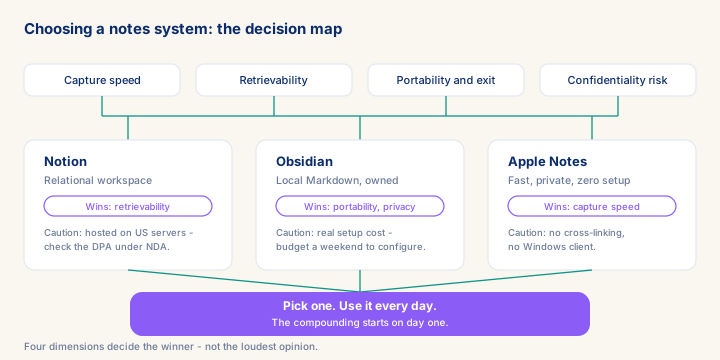
Notion, Obsidian, and Apple Notes rest on genuinely different trade-offs -- relational structure, local ownership, and zero-friction capture -- and consultants usually get the choice wrong in the same place: client confidentiality. Notion's default hosting sits on US-based servers, so a client name or system-architecture note taken under NDA in banking, pharma, or the public sector can create a GDPR Article 4 exposure nobody checked. Switching tools mid-engagement is not free either: budget 4-8 hours of migration work plus 2-4 weeks of degraded retrieval speed, which is exactly the wrong week to be slow on a client call. The decision that matters is not which tool wins in the abstract, but which one you will actually open in three seconds during a workshop and trust with a regulated client's notes. Pick one, use it daily, and be able to explain the choice in two sentences during a rate conversation.
What you will learn
- Evaluate Notion, Obsidian, and Apple Notes on the four dimensions that matter for a consultant: capture speed, retrievability, portability, and client-confidentiality risk
- Match each tool to the engagement context where it genuinely wins — and know when the difference is irrelevant
- Identify the hidden cost of switching tools mid-project and how to avoid productivity debt
- Frame your personal knowledge-management discipline as a differentiator in proposals and rate negotiations
Why this choice keeps consuming consultant attention
Every few months, a productivity influencer declares one of these three tools the definitive answer. Consultants — who are professional problem-solvers — are unusually susceptible to the meta-problem of optimising their tools rather than using them. The result: days spent migrating notes, building elaborate templates, and tuning plugins, with zero measurable improvement in the quality of deliverables or the speed of retrieval when a client asks a question on a call.
The honest answer to "Notion vs Obsidian vs Apple Notes" is: the one you will actually open. But that answer is too cheap to be useful without context. The three tools rest on genuinely different design philosophies that create real trade-offs for specific consultant workflows.
Prerequisites
- Review core concepts first: C087, C086, C091
Outcomes
- Work through a realistic scenario: A freelance SAP Datasphere consultant joins a four-month banking-sector migration and has to decide, before the first workshop.
- Recognize and avoid the anti-pattern: Treating tool choice as the deliverable — Days spent perfecting a Notion template while last week's client meeting notes are still unfiled.
- Apply the module's core decision: Where do client-confidential notes live.
- Track mastery with the KPI: Time-to-first-note in a live meeting (target: Under 10 seconds from decision to typing; red flag: Over 30 seconds -- capture friction means the note does not get taken at all).
Full module available to members. The full module adds: the decision framework · the end-to-end scenario walkthrough · the KPI scorecard · the anti-patterns · the knowledge check · the diagrams.